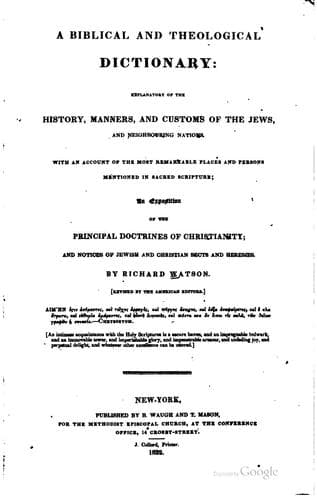
A Biblical and Theological Dictionary: explanatory of the history, manners, and customs of the Jews, and neighbouring nationsWatson, Richard
Religion
A Biblical and Theological Dictionary: explanatory of the history, manners, and customs of the Jews, and neighbouring nations
Watson, Richard
Bible -- Dictionaries; Theology -- Dictionaries
As to the doctrine of tutelary or guarding angels, presiding over the
affairs of empires, nations, provinces, and particular persons, though
received by the later Jews, it appears to be wholly Pagan in its origin,
and to have no countenance in the Scriptures. The passages in Daniel
brought to favour this notion are capable of a much better explanation;
and when our Lord declares that the “_angels_” of little children “do
always behold the face of God,” he either speaks of children as being
the objects of the general ministry of angels, or, still more probably,
by _angels_ he there means the disembodied spirits of children; for that
the Jews called disembodied spirits by the name of angels, appears from
Acts xii, 15.
On this question of guardian angels, Bishop Horsley observes: “That the
holy angels are often employed by God in his government of this
sublunary world, is indeed to be clearly proved by holy writ. That they
have power over the matter of the universe, analogous to the powers over
it which men possess, greater in extent, but still limited, is a thing
which might reasonably be supposed, if it were not declared. But it
seems to be confirmed by many passages of holy writ; from which it seems
also evident that they are occasionally, for certain specific purposes,
commissioned to exercise those powers to a prescribed extent. That the
evil angels possessed before their fall the like powers, which they are
still occasionally permitted to exercise for the punishment of wicked
nations, seems also evident. That they have a power over the human
sensory, which they are occasionally permitted to exercise, and by means
of which they may inflict diseases, suggest evil thoughts, and be the
instruments of temptation, must also be admitted. But all this amounts
not to any thing of a discretional authority placed in the hands of
tutelar angels, or to an authority to advise the Lord God with respect
to the measures of his government. Confidently I deny that a single text
is to be found in holy writ, which, rightly understood, gives the least
countenance to the abominable doctrine of such a participation of the
holy angels in God’s government of the world. In what manner then, it
may be asked, are the holy angels made at all subservient to the
purposes of God’s government? This question is answered by St. Paul in
his Epistle to the Hebrews, in the last verse of the first chapter; and
this is the only passage in the whole Bible in which we have any thing
explicit upon the office and employment of angels: ‘Are they not all,’
saith he, ‘ministering spirits, sent forth to minister for them that
shall be heirs of salvation?’ They are all, however high in rank and
order, nothing more than ‘ministering spirits,’ or, literally, ‘serving
spirits;’ not invested with authority of their own, but ‘sent forth,’
occasionally sent forth, to do such service as may be required of them,
‘for them that shall be heirs of salvation.’”
Public-domain text, read in full here on John Shaqi.
Reviews
Reviews
No reviews yet
Be the first to share your thoughts on this work.
Elsewhere in the archive
Join the Discussion
Join the discussion
Sign in to leave a comment or review.
Sign InorCreate an account