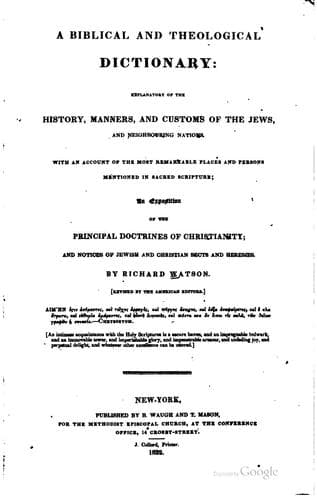
A Biblical and Theological Dictionary: explanatory of the history, manners, and customs of the Jews, and neighbouring nationsWatson, Richard
Religion
A Biblical and Theological Dictionary: explanatory of the history, manners, and customs of the Jews, and neighbouring nations
Watson, Richard
Bible -- Dictionaries; Theology -- Dictionaries
same class of angels is probable; but that they all should be but
different appellations of one common and equal order is improbable. We
learn also from Scripture, that they dwell in the immediate presence of
God; that they “excel in strength;” that they are immortal; and that
they are the agents through which God very often accomplishes his
special purposes of judgment and mercy. Nothing is more frequent in
Scripture than the missions and appearances of good and bad angels, whom
God employed to declare his will; to correct, teach, reprove, and
comfort. God gave the law to Moses, and appeared to the old patriarchs,
by the mediation of angels, who represented him, and spoke in his name,
Acts vii, 30, 35; Gal. iii, 19; Heb. xiii, 2.
Though the Jews, in general, believed the existence of angels, there was
a sect among them, namely, the Sadducees, who denied the existence of
all spirits whatever, God only excepted, Acts xxiii, 8. Before the
Babylonish captivity, the Hebrews seem not to have known the names of
any angel. The Talmudists say they brought the names of angels from
Babylon. Tobit, who is thought to have resided in Nineveh some time
before the captivity, mentions the angel Raphael, Tob. iii, 17; xi, 2,
7; and Daniel, who lived at Babylon some time after Tobit, has taught us
the names of Michael and Gabriel, Dan. viii, 16; ix, 21; x, 21. In the
New Testament, we find only the two latter mentioned by name.
There are various opinions as to the time when the angels were created.
Some think this took place when our heavens and the earth were made. For
this opinion, however, there is no just foundation in the Mosaic
account. Others think that angels existed long before the formation of
our solar system; and Scripture seems to favour this opinion, Job
xxxviii, 4, 7, where God says, “Where wast thou when I laid the
foundations of the earth?--and all the sons of God shouted for joy.”
Though it be a universal opinion that angels are of a spiritual and
incorporeal nature, yet some of the fathers, misled by a passage in Gen.
vi, 2, where it is said, “The sons of God saw the daughters of men, that
they were fair, and they took them wives of all which they chose,”
imagined them to be corporeal, and capable of sensual pleasures. But,
without noticing all the wild reveries which have been propagated by
bold or ignorant persons, let it suffice to observe, that by “the sons
of God” we are evidently to understand the descendants of Seth, who, for
the great piety wherein they continued for some time, were so called;
and that “the daughters of men” were the progeny of wicked Cain.
Public-domain text, read in full here on John Shaqi.
Reviews
Reviews
No reviews yet
Be the first to share your thoughts on this work.
Elsewhere in the archive
Join the Discussion
Join the discussion
Sign in to leave a comment or review.
Sign InorCreate an account