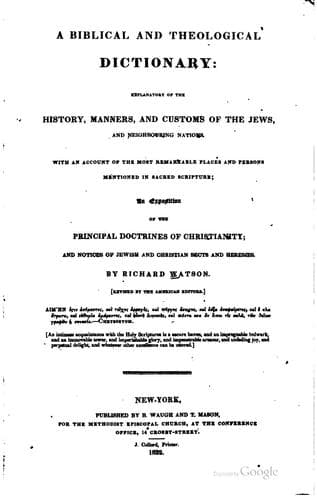
A Biblical and Theological Dictionary: explanatory of the history, manners, and customs of the Jews, and neighbouring nationsWatson, Richard
Religion
A Biblical and Theological Dictionary: explanatory of the history, manners, and customs of the Jews, and neighbouring nations
Watson, Richard
Bible -- Dictionaries; Theology -- Dictionaries
When the Angel of the Lord found Hagar in the wilderness, “she called
the name of JEHOVAH that spake to her, Thou God seest me.”--JEHOVAH
appeared unto Abraham in the plains of Mamre. Abraham lifted up his
eyes, and three _men_, three persons in human form, “stood by him.” One
of the three is called Jehovah. And JEHOVAH said, “Shall I hide from
Abraham the thing that I do?” Appearances of the same personage occur to
Isaac and to Jacob under the name of “the God of Abraham, and of Isaac.”
After one of these manifestations, Jacob says, “I have seen God face to
face;” and at another, “Surely the Lord (JEHOVAH) is in this place.” The
same Jehovah was made visible to Moses, and gave him his commission; and
God said, “I AM THAT I AM; thou shalt say to the children of Israel, I
AM hath sent me unto you.” The same JEHOVAH went before the Israelites
by day in a pillar of cloud, and by night in a pillar of fire; and by
Him the law was given amidst terrible displays of power and majesty from
Mount Sinai. “I am the Lord (JEHOVAH) thy God, which have brought thee
out of the land of Egypt, out of the house of bondage: Thou shalt have
no other gods before me,” &c. The collation of a few passages, or of the
different parts of the same passages, of Scripture, will show that
Jehovah, and “the Angel of the Lord,” when used in this eminent sense,
are the same person. Jacob says of Bethel, where he had exclaimed,
“Surely _Jehovah_ is in this place;” “The _Angel_ of God appeared to me
in a dream, saying, I am the God of Bethel.” Upon his death bed he gives
the names of _God_ and _Angel_ to this same person: “The _God_ which fed
me all my life long unto this day, the _Angel_ which redeemed me from
all evil, bless the lads.” So in Hosea xii, 2, 5, it is said, “By his
strength he had power with _God_; yea, he had power over the _Angel_,
and prevailed.” “We found him in Bethel, and there he spake with us,
even the _Lord God of Hosts_; the Lord is his memorial.” Here the same
person has the names, _God_, _Angel_, and _Lord God of Hosts_. “The
_Angel of the Lord_ called to Abraham a second time from heaven, and
said, By _myself_ have I sworn, saith the Lord, (JEHOVAH,) that, since
thou hast done this thing, in blessing will I bless thee.” The _Angel of
the Lord_ appeared to Moses in a flame of fire; but this same Angel
“called to him out of the bush, and said, I am the God of thy fathers,
the God of Abraham, the God of Isaac, and the God of Jacob; and Moses
hid his face, for he was afraid to look upon God.” To omit many other
passages, St. Stephen, in alluding to this part of the history of Moses,
in his speech before the council, says, “There appeared to Moses in the
wilderness of Mount Sinai, _an Angel of the Lord_ in a flame of fire,”
showing that that phraseology was in use among the Jews in his day, and
that this Angel and Jehovah were regarded as the same being; for he
adds, “Moses was in the church in the wilderness with the _Angel_ which
Public-domain text, read in full here on John Shaqi.
Reviews
Reviews
No reviews yet
Be the first to share your thoughts on this work.
Elsewhere in the archive
Join the Discussion
Join the discussion
Sign in to leave a comment or review.
Sign InorCreate an account