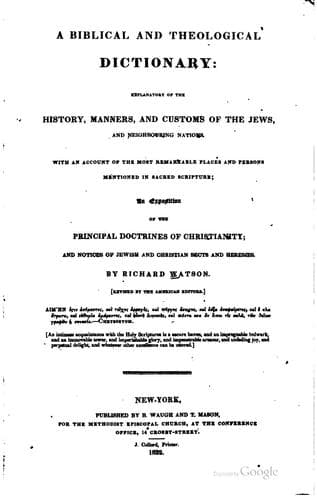
A Biblical and Theological Dictionary: explanatory of the history, manners, and customs of the Jews, and neighbouring nationsWatson, Richard
Religion
A Biblical and Theological Dictionary: explanatory of the history, manners, and customs of the Jews, and neighbouring nations
Watson, Richard
Bible -- Dictionaries; Theology -- Dictionaries
spoke unto him in Mount Sinai.” There is one part of the history of the
Jews in the wilderness, which so fully shows that they distinguished
this Angel of Jehovah from all created angels, as to deserve particular
attention. In Exodus xxiii, 20, God makes this promise to Moses and the
Israelites: “Behold, I send an Angel before thee to keep thee in the
way, and to bring thee into the place which I have prepared. Beware of
him, and obey his voice; provoke him not; for he will not pardon your
transgressions, for my name is in him.” Of this Angel let it be
observed, that he is here represented as the guide and protector of the
Israelites; to him they were to owe their conquests and their settlement
in the promised land, which are in other places often attributed to the
_immediate_ agency of God; that they are cautioned to “beware of him,”
to reverence and stand in dread of him; that the pardoning of
transgressions belongs to him; finally, “that the _name_ of God was in
him.” This _name_ must be understood of God’s own peculiar name,
JEHOVAH, I AM, which he assumed as his distinctive appellation at his
first appearing to Moses; and as the names of God are indicative of his
nature, he who had a right to bear the peculiar name of God, must also
have his essence. This view is put beyond all doubt by the fact, that
Moses and the Jews so understood the matter; for afterward when their
sins had provoked God to threaten not to go up with them _himself_, but
to commit them to “an angel who should drive out the Canaanite,” &c, the
people mourned over this as a great calamity, and Moses betook himself
to special intercession, and rested not until he obtained the repeal of
the threat, and the renewed promise, “My _presence_ shall go with thee,
and I will give thee rest.” Nothing, therefore, can be more clear than
that Moses and the Israelites considered the promise of the Angel, in
whom was “the name of God,” as a promise that God _himself_ would go
with them. With this uncreated Angel, this _presence_ of the Lord, they
were satisfied, but not with “an angel” indefinitely, who was by
_nature_ of that order of beings usually so called, and therefore a
created being; for at the news of God’s determination not to go up with
them, Moses hastens to the tabernacle to make his intercessions, and
refuses an inferior conductor:--“If thy presence go not with me, carry
us not up hence.”
Public-domain text, read in full here on John Shaqi.
Reviews
Reviews
No reviews yet
Be the first to share your thoughts on this work.
Elsewhere in the archive
Join the Discussion
Join the discussion
Sign in to leave a comment or review.
Sign InorCreate an account