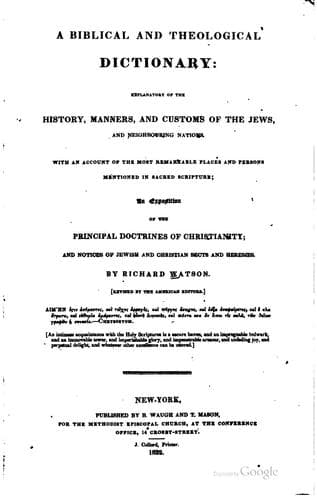
A Biblical and Theological Dictionary: explanatory of the history, manners, and customs of the Jews, and neighbouring nationsWatson, Richard
Religion
A Biblical and Theological Dictionary: explanatory of the history, manners, and customs of the Jews, and neighbouring nations
Watson, Richard
Bible -- Dictionaries; Theology -- Dictionaries
ANOINT, to pour oil upon, Gen. xxviii, 18; xxxi, 13. The setting up of a
stone and anointing it by Jacob, as here recorded, in grateful memory of
his celestial vision, probably became the occasion of idolatry in
succeeding ages, and gave rise to the erection of temples composed of
shapeless masses of unhewn stone, of which so many astonishing remains
are scattered up and down the Asiatic and the European world.
Under the law persons and things set apart for sacred purposes were
anointed with the holy oil; which appears to have been a typical
representation of the communication of the Holy Ghost to Christ and to
his church. See Exod. xxviii, xxix. Hence the Holy Spirit is called an
_unction_ or _anointing_, 1 John ii, 20, 27; and our Lord is called the
“Messiah,” or “Anointed One,” to denote his being called to the offices
of mediator, prophet, priest, and king, to all of which he was
consecrated by the anointing of the Holy Ghost, Matt. iii, 16, 17.
When we hear of the anointing of the Jewish kings, we are to understand
by it the same as their inauguration; inasmuch as anointing was the
principal ceremony on such an occasion, 2 Sam. ii, 4; v, 3. As far as we
are informed, however, unction, as a sign of investiture with the royal
authority, was bestowed only upon Saul and David, and subsequently upon
Solomon and Joash, who ascended the throne under such circumstances,
that there was danger of their right to the succession being forcibly
disputed, 1 Sam. x, 24; 2 Sam. ii, 4; v, 1–3; 1 Chron. xi, 1, 2; 2 Kings
xi, 12–20; 2 Chron. xxiii, 1–21. The ceremony of regal anointing needed
not to be repeated in every instance of succession to the throne,
because the unction which the first one who held the sceptre in any
particular line of princes had received was supposed to suffice for the
succeeding incumbents in the same descent.
In the kingdom of Israel, those who were inducted into the royal office
appear to have been inaugurated with some additional ceremonies, 2 Kings
ix, 13. The private anointings which we learn to have been performed by
the prophets, 2 Kings ix, 3, comp. 1 Sam. x, 1; xvi, 1–13, were only
prophetic symbols or intimations that the persons who were thus anointed
should eventually receive the kingdom.
The holy anointing oil which was made by Moses, Exod. xxx, 22–33, for
the maintaining and consecrating of the king, the high priest, and all
the sacred vessels made use of in the house of God, was one of those
things, as Dr. Prideaux observes, which was wanting in the second
temple. The oil made and consecrated for this use was commanded to be
kept by the children of Israel, throughout their generations, and
therefore it was laid up in the most holy place of the tabernacle and
the first temple.
Public-domain text, read in full here on John Shaqi.
Reviews
Reviews
No reviews yet
Be the first to share your thoughts on this work.
Elsewhere in the archive
Join the Discussion
Join the discussion
Sign in to leave a comment or review.
Sign InorCreate an account