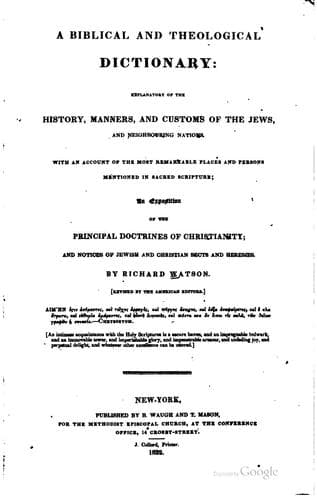
A Biblical and Theological Dictionary: explanatory of the history, manners, and customs of the Jews, and neighbouring nationsWatson, Richard
Religion
A Biblical and Theological Dictionary: explanatory of the history, manners, and customs of the Jews, and neighbouring nations
Watson, Richard
Bible -- Dictionaries; Theology -- Dictionaries
ANISE, an annual umbeliferous plant, the seeds of which have an aromatic
smell, a pleasant warm taste, and a carminative quality. But by ἄνηθον,
Matt. xxiii, 23, the _dill_ is meant. Our translators seem to have been
first misled by a resemblance of the sound. No other versions have
fallen into the mistake. The Greek of _anise_ is ἄνισον; but of _dill_,
ἄνηθον.
ANNA, the daughter of Phanuel, a prophetess and widow, of the tribe of
Asher, Luke ii, 36, 37. She was married early, and had lived only seven
years with her husband. Being then disengaged from the ties of marriage,
she thought only of pleasing the Lord; and continued without ceasing in
the temple, serving God night and day, with fasting and prayer, as the
Evangelist expresses it. However, her serving God at the temple night
and day, says Dr. Prideaux, is to be understood no otherwise than that
she constantly attended the morning and evening sacrifice at the temple;
and then with great devotion offered up her prayers to God; the time of
morning and evening sacrifice being the most solemn time of prayer among
the Jews, and the temple the most solemn place for this devotion. Anna
was fourscore years of age when the holy virgin came to present Jesus in
the temple; and entering accidentally, while Simeon was pronouncing his
thanksgiving, she likewise began to praise God, and to speak of the
Messiah to all those who waited for redemption in Jerusalem. We know
nothing more either of the life or death of this holy woman.
ANNAS, or ANANUS, as Josephus calls him, was the son of Seth, and high
priest of the Jews. He succeeded Joazar, the son of Simon, enjoyed the
high priesthood eleven years, and was succeeded by Ishmael, the son of
Phabi. After he was deposed, he still preserved the title of high
priest, and had a great share in the management of public affairs. He is
called high priest in conjunction with Caiaphas, when John the Baptist
entered upon the exercise of his mission; though Calmet thinks that at
that time he did not, strictly speaking, possess or officiate in that
character, Luke iii, 2. On the contrary, Macknight and some others are
of opinion, that at this time Caiaphas was only the deputy of Annas. He
was father-in-law to Caiaphas; and Jesus Christ was carried before him,
directly after his seizure in the garden of Olives, John xviii, 13.
Josephus remarks, that Annas was considered as one of the happiest men
of his nation, for five of his sons were high priests, and he himself
possessed that great dignity many years. This was an instance of good
fortune which, till that time, had happened to no person.
Public-domain text, read in full here on John Shaqi.
Reviews
Reviews
No reviews yet
Be the first to share your thoughts on this work.
Elsewhere in the archive
Join the Discussion
Join the discussion
Sign in to leave a comment or review.
Sign InorCreate an account