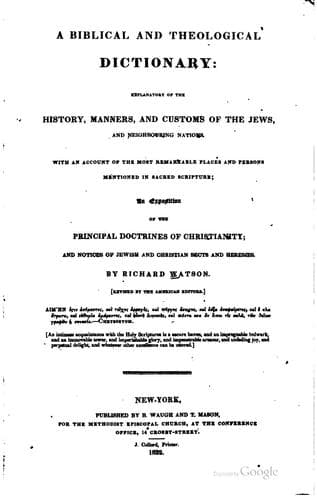
A Biblical and Theological Dictionary: explanatory of the history, manners, and customs of the Jews, and neighbouring nationsWatson, Richard
Religion
A Biblical and Theological Dictionary: explanatory of the history, manners, and customs of the Jews, and neighbouring nations
Watson, Richard
Bible -- Dictionaries; Theology -- Dictionaries
“Till the manners of exotic ants are more accurately explored, it would
be rash to affirm that no ants have magazines of provisions; for,
although, during the cold of our winters in this country, they remain in
a state of torpidity, and have no need of food, yet in warmer regions,
during the rainy seasons, when they are probably confined to their
nests, a store of provisions may be necessary for them. Even in northern
climates, against wet seasons, they may provide in this way for their
sustenance and that of the young brood, which, as Mr. Smeatham observes,
are very voracious, and cannot bear to be long deprived of their food;
else why do ants carry worms, living insects, and many other such
things, into their nests? Solomon’s lesson to the sluggard has been
generally adduced as a strong confirmation of the ancient opinion: it
can, however, only relate to the species of a warm climate, the habits
of which are probably different from those of a cold one; so that his
words, as commonly interpreted, may be perfectly correct and consistent
with nature, and yet be not at all applicable to the species that are
indigenous to Europe.”
The ant, according to the royal preacher, is one of those things which
are little upon the earth, but exceeding _wise_. The superior wisdom of
the ant has been recognised by many writers. Horace in the passage from
which the preceding quotation is taken, praises its sagacity; Virgil
celebrates its foresight, in providing for the wants and infirmities of
old age, while it is young and vigorous:--
----_atque inopi metuens formica senectæ._
[And the ant dreading a destitute old age.]
And we learn from Hesiod, that among the earliest Greeks it was called
Idris, that is, wise, because it foresaw the coming storm, and the
inauspicious day, and collected her store. Cicero believed that the ant
is not only furnished with senses, but also with mind, reason and
memory:--_In formica non modo sensus sed etiam mens, ratio, memoria_.
[The ant possesses not only senses, but also mind, reason, memory.] The
union of so many noble qualities in so small a corpuscle, is indeed one
of the most remarkable phenomena in the works of nature.
ANTHROPOMORPHITES, a sect of ancient heretics, who were so denominated
from two Greek words ἄνθρωπος, _man_, and μόρφη, _shape_. They
understood every thing spoken in Scripture in a literal sense, and
particularly that passage of Genesis in which it is said, “God made man
after his own image.” Hence they maintained, that God had a human shape.
Public-domain text, read in full here on John Shaqi.
Reviews
Reviews
No reviews yet
Be the first to share your thoughts on this work.
Elsewhere in the archive
Join the Discussion
Join the discussion
Sign in to leave a comment or review.
Sign InorCreate an account