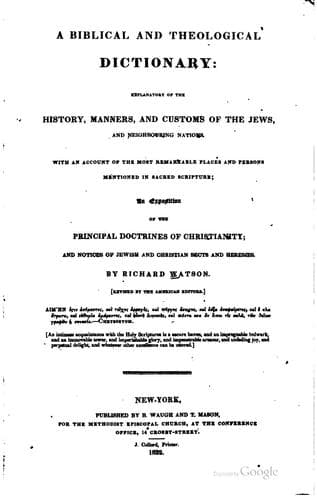
A Biblical and Theological Dictionary: explanatory of the history, manners, and customs of the Jews, and neighbouring nationsWatson, Richard
Religion
A Biblical and Theological Dictionary: explanatory of the history, manners, and customs of the Jews, and neighbouring nations
Watson, Richard
Bible -- Dictionaries; Theology -- Dictionaries
ANTHROPOPATHY, a metaphor by which things belonging to creatures and
especially to man are ascribed to God. Instances of this abound in the
Scriptures, by which they adapt themselves to human modes of speaking,
and to the limited capacities of men. These anthropopathies we must
however interpret in a manner suitable to the majesty of the divine
nature. Thus, when the members of a human body are ascribed to God, we
must understand by them those perfections of which such members in us
are the instruments. The _eye_, for instance, represents God’s knowledge
and watchful care; the _arm_, his power and strength; the _ears_, the
regard he pays to prayer and to the cry of oppression and misery, &c.
Farther, when human affections are attributed to God, we must so
interpret them as to imply no imperfection, such as perturbed feeling in
him. When God is said to repent, the antecedent, by a frequent figure of
speech, is put for the consequent; and in this case we are to understand
an altered mode of proceeding on the part of God, which in man is the
effect of repenting.
ANTICHRIST, compounded of ἀντὶ, _contra_, _against_, and Χριϛὸς,
_Christ_, in a general sense, denotes an adversary of Christ, or one who
denies that the Messiah is come. In this sense, Jews, infidels, &c, may
be said to be _antichrists_. The epithet, in the _general_ sense of it,
is also applicable to any power or person acting in direct opposition to
Christ or his doctrine. Its _particular_ meaning is to be collected from
those passages of Scripture in which it occurs. Accordingly, it may
either signify one who assumes the place and office of Christ, or one
who maintains a direct enmity and opposition to him. The Fathers all
speak of antichrist as a single man; though they also assure us, that he
is to have divers precursors, or forerunners. Yet many Protestant
writers apply to the Romish church, and the pope who is at the head of
it, the several marks and signatures of antichrist enumerated in the
Apocalypse, which would imply antichrist to be, not a single person, but
a corrupt society, or a long series of persecuting pontiffs, or rather,
a certain power and government, that may be held for many generations,
by a number of individuals succeeding one another. The antichrist
mentioned by the Apostle John, first Epistle ii, 18, and more
particularly described in the book of Revelation, seems evidently to be
the same with the _man of sin_, &c, characterized by St. Paul in his
Second Epistle to the Thessalonians, chap. ii; and the whole description
literally applies to the Papal power. A late writer, after collecting
the principal prophecies relating to antichrist, infers from them that a
power, sometimes represented as the little horn, the man of sin, the
antichrist, the beast, the harlot, the star falling from heaven, the
false prophet, the dragon, or as the operation of false teachers, was to
be expected to arise in the Christian world to persecute and oppress,
Public-domain text, read in full here on John Shaqi.
Reviews
Reviews
No reviews yet
Be the first to share your thoughts on this work.
Elsewhere in the archive
Join the Discussion
Join the discussion
Sign in to leave a comment or review.
Sign InorCreate an account