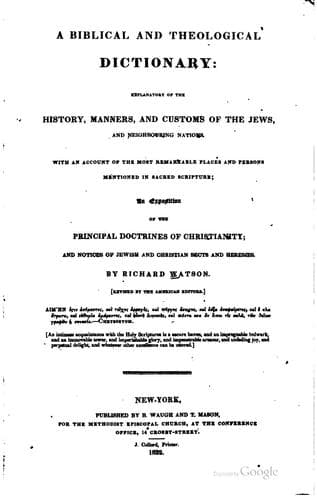
A Biblical and Theological Dictionary: explanatory of the history, manners, and customs of the Jews, and neighbouring nationsWatson, Richard
Religion
A Biblical and Theological Dictionary: explanatory of the history, manners, and customs of the Jews, and neighbouring nations
Watson, Richard
Bible -- Dictionaries; Theology -- Dictionaries
6. ANTIOCHUS THEOS, or the _Divine_, the son of Alexander Balas, king of
Syria, was brought up by the Arabian prince Elmachuel, or, as he is
called in the Greek, Simalcue, 1 Mac. xi, 39, 40, &c. Demetrius Nicanor,
king of Syria, having rendered himself odious to his troops, one
Diodotus, otherwise called Tryphon, came to Zabdiel, a king in Arabia,
and desired him to entrust him with young Antiochus, whom he promised to
place on the throne of Syria, which was then possessed by Demetrius
Nicanor. After some hesitation, Zabdiel complied with the request; and
Tryphon carried Antiochus into Syria, and put the crown on his head. The
troops dismissed by Demetrius, came and joined Tryphon, who, having
formed a powerful army, defeated Demetrius, and forced him to retreat to
Seleucia. Tryphon seized his elephants, and rendered himself master of
Antioch, in the year of the world 3859, and before Jesus Christ 145.
Antiochus Theos, to strengthen himself in his new acquisition, sent
letters to Jonathan Maccabæus, high priest and prince of the Jews,
confirming him in the high priesthood, and granting him four toparchies,
or four considerable places, in Judea. He also received Jonathan into
the number of his friends, sent him vessels of gold, permitted him to
use a gold cup, to wear purple, and a golden buckle; and he gave his
brother, Simon Maccabæus, the command of all his troops on the coast of
the Mediterranean, from Tyre to Egypt. Jonathan, engaged by so many
favours, declared resolutely for Antiochus, or rather for Tryphon, who
reigned under the name of this young prince; and on several occasions,
he attacked the generals of Demetrius, who still possessed many places
beyond Jordan and in Galilee, 1 Macc. xi, 63, &c; xii, 24, 34. Tryphon,
seeing young Antiochus in peaceable possession of the kingdom of Syria,
resolved to usurp his crown. He thought it necessary, in the first
place, to secure Jonathan Maccabæus who was one of the most powerful
supporters of Antiochus’s throne. He came, therefore, with troops into
Judea, invited Jonathan to Ptolemais, and there, on frivolous pretences,
made him prisoner. However, Simon, Jonathan’s brother, headed the troops
of Judea, and opposed Tryphon, who intended to take Jerusalem. Tryphon,
being disappointed, put Jonathan to death at Bassa or Bascama, and
returned into Syria, where, without delay, he executed his design of
killing Antiochus. He corrupted the royal physicians, who, having
published that Antiochus was tormented with the stone, murdered him, by
cutting him without any necessity. Thus Tryphon was left master of
Syria, in the year of the world 3861, and before Jesus Christ 143.
Public-domain text, read in full here on John Shaqi.
Reviews
Reviews
No reviews yet
Be the first to share your thoughts on this work.
Elsewhere in the archive
Join the Discussion
Join the discussion
Sign in to leave a comment or review.
Sign InorCreate an account