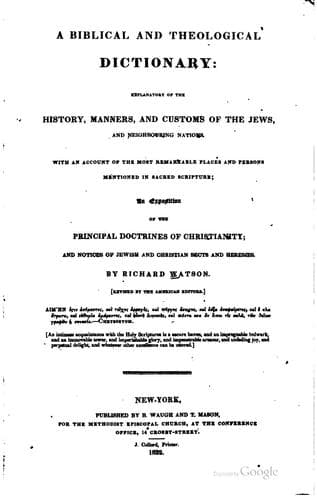
A Biblical and Theological Dictionary: explanatory of the history, manners, and customs of the Jews, and neighbouring nationsWatson, Richard
Religion
A Biblical and Theological Dictionary: explanatory of the history, manners, and customs of the Jews, and neighbouring nations
Watson, Richard
Bible -- Dictionaries; Theology -- Dictionaries
transported with indignation; and, threatening to make Jerusalem a grave
for the Jews, commanded the driver of his chariot to urge the horses
forward, and to hasten his journey. However, divine vengeance soon
overtook him: he fell from his chariot, and bruised all his limbs. He
was also tormented with such pains in his bowels, as allowed him no
rest; and his disease was aggravated by grief and vexation. In this
condition he wrote to the Jews very humbly, promised them many things,
and engaged even to turn Jew, if God would restore him to health. He
earnestly recommended to them his son Antiochus, who was to succeed him,
and entreated them to favour the young prince, and to continue faithful
to him. He died, overwhelmed with pain and grief, in the mountains of
Paratacene, in the little town of Tabes, in the year of the world 3840,
and before Jesus Christ 164.
5. ANTIOCHUS EUPATOR, son of Antiochus Epiphanes, was only nine years
old when his father died and left him the kingdom of Syria. Lysias, who
governed the kingdom in the name of the young prince, led against Judea
an army of one hundred thousand foot, twenty thousand horse, and thirty
elephants, 1 Mac. vi; 2 Mac. xiii. He besieged and took the fortress of
Bethsura, and thence marched against Jerusalem. The city was ready to
fall into his hands when Lysias received the news that Philip, whom
Antiochus Epiphanes had entrusted with the regency of the kingdom, had
come to Antioch to take the government, according to the disposition of
the late king. He therefore proposed an accommodation with the Jews,
that he might return speedily to Antioch and oppose Philip. After
concluding a peace, he immediately returned into Syria, with the young
king and his army.
In the meantime, Demetrius Soter, son of Seleucus Philopator, and nephew
to Antiochus Epiphanes, to whom by right the kingdom belonged, having
escaped from Rome, came into Syria. Finding the people disposed for
revolt, Demetrius headed an army, and marched directly to Antioch,
against Antiochus and Lysias. However, the inhabitants did not wait till
he besieged the city; but opened the gates, and delivered to him Lysias
and the young king Antiochus Eupator, whom Demetrius caused to be put to
death, without suffering them to appear in his presence. Antiochus
Eupator reigned only two years, and died in the year of the world 3842,
and before Jesus Christ 162.
Public-domain text, read in full here on John Shaqi.
Reviews
Reviews
No reviews yet
Be the first to share your thoughts on this work.
Elsewhere in the archive