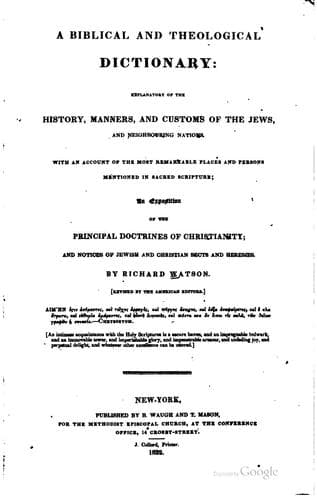
A Biblical and Theological Dictionary: explanatory of the history, manners, and customs of the Jews, and neighbouring nationsWatson, Richard
Religion
A Biblical and Theological Dictionary: explanatory of the history, manners, and customs of the Jews, and neighbouring nations
Watson, Richard
Bible -- Dictionaries; Theology -- Dictionaries
Antipas, returning to Judea, took great pains in adorning and fortifying
the principal places of his dominions. He married the daughter of
Aretas, king of Arabia, whom he divorced about A. D. 33, that he might
marry his sister-in-law, Herodias, the wife of his brother Philip, who
was still living. John the Baptist, exclaiming against this incest, was
seized by order of Antipas, and imprisoned in the castle of Machærus.
Josephus says, that Antipas caused John to be taken, because he drew too
great a concourse after him; and Antipas was afraid he should use his
influence over the people to induce them to revolt. But Josephus has
reported the pretence for the true cause. The evangelists, who were
better informed than Josephus, as being eye witnesses of what passed,
and particularly acquainted with John and his disciples, assure us, that
the true reason of imprisoning John was the aversion of Herod and
Herodias against him, on account of his liberty in censuring their
scandalous marriage, Matt. xiv, 3, 4; Mark vi, 14, 17, 18; Luke iii, 19,
20. When the king was celebrating his birth day, with the principal
persons of his court, the daughter of Herodias danced before them, and
pleased him so well that he swore to give her whatever she should ask.
She consulted her mother, who advised her to ask the head of John the
Baptist. Returning, therefore, to the hall, she addressed herself to the
king, and said, “Give me here John Baptist’s head in a charger.” The
king was afflicted at this request; but in consideration of his oath,
and of the persons at table with him, he sent one of his guards, who
beheaded John in prison. The head was brought in, and given to the young
woman, who delivered it to her mother, Matt. xiv, 5, 6, &c. Aretas, king
of Arabia, to revenge the affront which Herod had offered to his
daughter, declared war against him, and vanquished him in a very
obstinate contest. Josephus tells us, that the Jews attributed the
defeat of Herod to the death of John the Baptist. In the year of the
Christian æra 39, Herodias being jealous of the prosperity of her
brother Agrippa, who from a private person had become king of Judea,
persuaded her husband, Herod-Antipas, to visit Rome, and desire the same
dignity of the emperor Caius. She resolved to accompany him; and hoped
that her presents and appearance would contribute to procure the
emperor’s favour. However, Agrippa obtaining intelligence of this
design, wrote to the emperor and accused Antipas. The messenger of
Agrippa arrived at Baiæ, where the emperor was, at the very time when
Herod received his first audience. Caius, on the delivery of Agrippa’s
letters, read them with great earnestness. In these letters, Agrippa
accused Antipas of having been a party in Sejanus’s conspiracy against
Tiberius, and said that he still carried on a correspondence with
Artabanus, king of Partha, against the Romans. As a proof of this, he
affirmed that Antipas had in his arsenals arms for seventy thousand men.
Public-domain text, read in full here on John Shaqi.
Reviews
Reviews
No reviews yet
Be the first to share your thoughts on this work.
Elsewhere in the archive
Join the Discussion
Join the discussion
Sign in to leave a comment or review.
Sign InorCreate an account