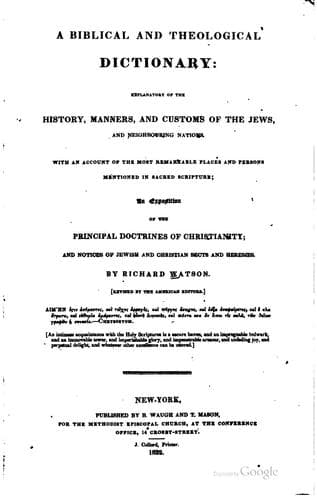
A Biblical and Theological Dictionary: explanatory of the history, manners, and customs of the Jews, and neighbouring nationsWatson, Richard
Religion
A Biblical and Theological Dictionary: explanatory of the history, manners, and customs of the Jews, and neighbouring nations
Watson, Richard
Bible -- Dictionaries; Theology -- Dictionaries
Caius being angry, demanded hastily of Antipas, if it were true that he
had such a quantity of arms? The king not daring to deny it, was
instantly banished to Lyons in Gaul. The emperor offered to forgive
Herodias, in consideration of her brother Agrippa; but she chose rather
to follow her husband, and to share his fortune in banishment. This is
that Antipas, who, being at Jerusalem at the time of our Saviour’s
passion, ridiculed Jesus whom Pilate had sent to him, dressed him in
worn-out royalty, and sent him back to Pilate as a mock king, whose
ambition gave him no umbrage, Luke xxiii, 7, 11. The year of the death
of Antipas is unknown; but it is certain that he, as well as Herodias,
died in exile. Josephus says, that he died in Spain, whither Caius, on
his coming into Gaul the first year of his banishment, might order him
to be sent.
2. ANTIPAS, the faithful martyr or witness mentioned in the book of
Revelation, ii, 13. He is said to have been one of our Saviour’s first
disciples, and to have suffered martyrdom at Pergamus, of which he was
bishop. His Acts relate that he was burnt in a brazen bull. Though
ancient ecclesiastical history furnishes no account of this Antipas, yet
it is certain that, according to all the rules of language, what is said
concerning him by St. John must be understood literally, and not
mystically, as some interpreters have done.
ANTIPATRIS, Acts xxiii, 31, a town in Palestine, anciently called
Caphar-Saba, according to Josephus; but named Antipatris by Herod the
Great, in honour of his father Antipater. It was situated in a pleasant
valley, near the mountains, in the way from Jerusalem to Cæsarea.
Josephus places it at about the distance of seventeen miles from Joppa.
To this place St. Paul was brought in his way to the governor of Judea
at Cæsarea, Acts xxiii, 31.
ANTITYPE, that which answers to a type or figure. A type is a model,
mould, or pattern; that which is formed according to it is an antitype.
See TYPE.
ANTONIA, one of the towers of Jerusalem, called by Herod after M.
Antony. The Romans generally kept a garrison in this tower; and from
thence it was that the tribune ran with his soldiers to rescue St. Paul
out of the hands of the Jews, who had seized him in the temple, and
designed to have murdered him, Acts xxi, 31, 32.
Public-domain text, read in full here on John Shaqi.
Reviews
Reviews
No reviews yet
Be the first to share your thoughts on this work.
Elsewhere in the archive
Join the Discussion
Join the discussion
Sign in to leave a comment or review.
Sign InorCreate an account