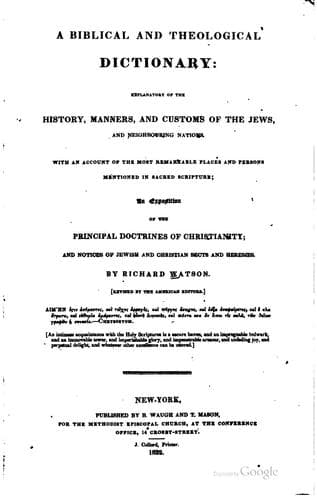
A Biblical and Theological Dictionary: explanatory of the history, manners, and customs of the Jews, and neighbouring nationsWatson, Richard
Religion
A Biblical and Theological Dictionary: explanatory of the history, manners, and customs of the Jews, and neighbouring nations
Watson, Richard
Bible -- Dictionaries; Theology -- Dictionaries
APOSTASY, a deserting or abandoning of the true religion. The word is
borrowed from the Latin _apostatare_, or _apostare_, _to despise_ or
_violate_ any thing. Hence _apostatare leges_ anciently signified _to
transgress the laws_. The Latin _apostatare_, again, comes from ἀπὸ,
_from_, and ἳϛημι, _I stand_. Among the Romanists, apostasy also
signifies the forsaking of a religious order, whereof a man had made
profession, without a lawful dispensation. The ancients distinguished
three kinds of apostasy: the first, _a supererogatione_, is committed by
a priest, or religious, who abandons his profession, and returns to his
lay state; the second, _a mandatis Dei_, by a person of any condition,
who abandons the commands of God, though he retains his faith; the
third, _a fide_, by him who not only abandons his works, but also the
faith. There is this difference between an apostate and a heretic; that
the latter only abandons a part of the faith, whereas the former
renounces the whole. The primitive Christian church distinguished
several kinds of apostasy. The first was that of those who relapsed from
Christianity into Judaism; the second, that of those who blended Judaism
and Christianity together; and the third was that of those who, after
having been Christians, voluntarily relapsed into Paganism.
APOSTLE, ἀπόϛολος, one of the twelve disciples of Jesus Christ,
commissioned by him to preach his Gospel, and propagate it to all parts
of the earth. The word originally signifies a person _delegated_ or
_sent_; from ἀποϛέλλω, _mitto_; in which sense it occurs in Herodotus,
and other profane authors. Hence, in the New Testament, the term is
applied to divers sorts of delegates; and to the twelve disciples by way
of eminence. They were limited to the number twelve, in allusion to the
twelve tribes of Israel. See Matt. xix, 28; Luke xxii, 30; Rev. xxi,
12–14; and compare Exod. xxiv, 4; Deut. i, 23; and Josh. iv, 2, 3.
Accordingly care was taken, on the death of Judas, to choose another, to
make up the number, Acts i, 21, 22, 26. Of the first selection and
commission of the twelve Apostles, we have an account, Luke vi, 13, &c;
Matt. x, 1, &c. Having chosen and constituted twelve persons, under the
name of Apostles, our blessed Lord determined that for some time they
should be continually with him, not only to attend upon his public
ministry, but to enjoy the benefit of his private conversation, that he
might furnish them the better for the great work in which they were to
be employed; and that, at length, after suitable preparation, he might,
with greater advantage, send them abroad to preach his Gospel, and thus
make way for his own visits to some more distant parts, where he had not
yet been; and to enable them more effectually to do this, he endowed
them with the power of working miracles, of curing diseases, and casting
out demons. About the commencement of the third year of his ministry,
Public-domain text, read in full here on John Shaqi.
Reviews
Reviews
No reviews yet
Be the first to share your thoughts on this work.
Elsewhere in the archive
Join the Discussion
Join the discussion
Sign in to leave a comment or review.
Sign InorCreate an account