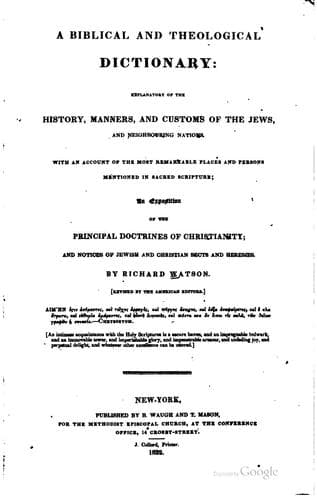
A Biblical and Theological Dictionary: explanatory of the history, manners, and customs of the Jews, and neighbouring nationsWatson, Richard
Religion
A Biblical and Theological Dictionary: explanatory of the history, manners, and customs of the Jews, and neighbouring nations
Watson, Richard
Bible -- Dictionaries; Theology -- Dictionaries
Some have supposed, that the Apostle names
Apollos and Cephas, not as the real persons in whose name parties had
been formed in Corinth, but that, in order to avoid provoking a temper
which he wished to subside, he transfers “by a figure” to Apollos and
himself what was really meant of other parties, whom from prudence he
declines to mention. However this might be, the reluctance of Apollos to
return to Corinth seems to countenance the general opinion. St. Jerom
says that Apollos was so dissatisfied with the division which had
happened on his account at Corinth, that he retired into Crete with
Zeno, a doctor of the law; but that the evil having been corrected by
the letter of St. Paul to the Corinthians, Apollos returned to that
city, of which he afterward became bishop. The Greeks say that he was
bishop of Duras; some, that he was bishop of Iconium, in Phrygia; and
others of Cæsarea.
APOLLYON. See ABADDON.
APOLOGIES, in ecclesiastical history, were defences (so the Greek word
means) of Christianity, presented to Heathen emperors, by the Christian
fathers, who were therefore called Apologists. The first was presented
to the emperor Adrian, by Quadratus, A. D. 126, a fragment of which is
preserved by Eusebius; but another, presented soon after to the same, by
Aristides, a converted Athenian philosopher, is totally lost. Justin
Martyr wrote two apologies; the latter (to the Roman senate) is
imperfect at the beginning; but the former, addressed to Antoninus Pius,
is preserved entire, and was published in English, in 1709, by the Rev.
W. Reeves, together with one by Tertullian, the Octavius (a dialogue) of
Minucius Felix, and the Commentary of Vincentius Lirinensis, with notes
and preliminary dissertations to each, in 2 vols. 8vo. The Apologies are
curious and valuable remains of antiquity, as showing what were the
objections of the Heathens, and the manner in which they were rebutted
by the early Christians.
Public-domain text, read in full here on John Shaqi.
Reviews
Reviews
No reviews yet
Be the first to share your thoughts on this work.
Elsewhere in the archive
Join the Discussion
Join the discussion
Sign in to leave a comment or review.
Sign InorCreate an account