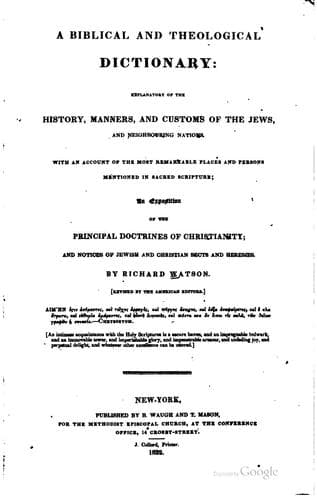
A Biblical and Theological Dictionary: explanatory of the history, manners, and customs of the Jews, and neighbouring nationsWatson, Richard
Religion
A Biblical and Theological Dictionary: explanatory of the history, manners, and customs of the Jews, and neighbouring nations
Watson, Richard
Bible -- Dictionaries; Theology -- Dictionaries
When Christianity had been preached for about eight years among the Jews
only, and for about three years more among the Jews and devout Gentiles,
the next stage of its progress was to the idolatrous Gentiles, in the
year of Christ 44, and the fourth year of the emperor Claudius. Barnabas
and Saul were selected for this purpose, and constituted in an
extraordinary manner Apostles of the Gentiles, or uncircumcision.
Barnabas was probably an elder of the first rank; he had seen Christ in
the flesh, had been an eye witness of his being alive again after his
crucifixion, and had received the Holy Spirit on the day of Pentecost,
as being one of the hundred and twenty. Saul also, since his conversion
had preached as a superior prophet, about seven years to the Jews only,
and about two years more to the Jews and devout Gentiles. They had both
been born in Gentile countries; and therefore may be supposed to have
had more respect and affection for the Gentiles than most of the Jews,
who were natives of Judea. Saul had been converted, and had hitherto
preached chiefly on Gentile ground; and he had joined with Barnabas in
teaching devout Gentiles for a whole year, at Antioch in Syria; by all
which previous steps they were regularly conducted to the last
gradation, or the conversion of the idolatrous Gentiles. But it was
necessary, in order to the being an Apostle, to have seen our Lord Jesus
Christ alive after his crucifixion, for the Apostles were in a peculiar
manner the witnesses of his resurrection. Some have supposed that Saul
saw the person of Jesus, when he was converted, near the city of
Damascus; but others, who conceive from the history of this event, that
this could not have been the case, as he was instantly struck blind, are
of opinion that the season, when his Apostolic qualification and
commission were completed, was that mentioned by himself, Acts xxii, 17,
when he returned to Jerusalem the second time after his conversion, saw
the Lord Jesus Christ in person, and received the command to go quickly
out of Jerusalem, that he might be sent unto the Gentiles. See also Acts
xxvi, 16–20, where he gives an account of the object of his commission.
He also received a variety of gifts and powers, which, superadded to his
own genius and learning, as well as fortitude and patience, eminently
qualified him for the office of an Apostle, and for that particular
exercise of it which was assigned to him. St. Paul is frequently called
the _Apostle_, by way of eminence; and the _Apostle of the Gentiles_,
because his ministry was chiefly employed for the conversion of the
Gentiles, as that of St. Peter was for Jews, who is therefore styled the
_Apostle of the circumcision_.
Public-domain text, read in full here on John Shaqi.
Reviews
Reviews
No reviews yet
Be the first to share your thoughts on this work.
Elsewhere in the archive
Join the Discussion
Join the discussion
Sign in to leave a comment or review.
Sign InorCreate an account