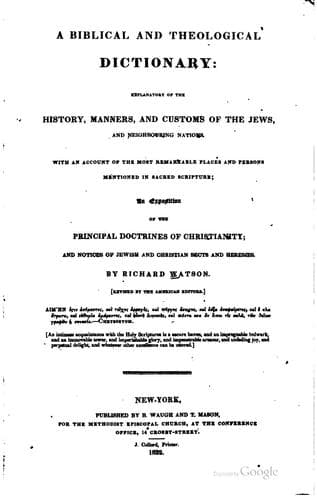
A Biblical and Theological Dictionary: explanatory of the history, manners, and customs of the Jews, and neighbouring nationsWatson, Richard
Religion
A Biblical and Theological Dictionary: explanatory of the history, manners, and customs of the Jews, and neighbouring nations
Watson, Richard
Bible -- Dictionaries; Theology -- Dictionaries
The Apostles having continued at Jerusalem twelve years after the
ascension of Christ, as tradition reports, according to his command,
determined to disperse themselves in different parts of the world. But
what were the particular provinces assigned to each, does not certainly
appear from any authentic history. Socrates says, that Thomas took
Parthia for his lot; Matthew, Ethiopia, and Bartholomew, India. Eusebius
gives the following account: “Thomas, as we learn by tradition, had
Parthia for his lot; Andrew, Scythia; John, Asia, who having lived there
a long time, died at Ephesus. Peter, as it seems, preached to the
dispersed Jews in Pontus and Galatia, Bithynia, Cappadocia, and Asia; at
length, coming to Rome, he was crucified with his head downward, as he
had desired. What need I to speak of St. Paul, who fully preached the
Gospel of Christ, from Jerusalem to Illyricum, and at last died a martyr
at Rome, in the time of Nero?” From this passage we may conclude, that
at the beginning of the fourth century, there were not any certain and
well attested accounts of the places out of Judea, in which several of
the Apostles of Christ preached; for if there had, Eusebius must have
been acquainted with them.
The stories that are told concerning their arrival and exploits among
the Gauls, the English, the Spaniards, the Germans, the Americans, the
Chinese, the Indians, and the Russians, are too romantic in their
nature, and of too recent a date, to be received by an impartial
inquirer after truth. These fables were for the most part forged after
the time of Charlemagne, when most of the Christian churches contended
about the antiquity of their origin, with as much vehemence as the
Arcadians, Egyptians, and Greeks disputed formerly about their seniority
and precedence.
It appears, however, that all of the Apostles did not die by martyrdom.
Heraclion, cited by Clemens Alexandrinus, reckons among the Apostles who
did not suffer martyrdom, Matthew, Thomas, Philip, and Levi, probably
meaning Lebbeus.
To the Apostles belonged the peculiar and exclusive prerogative of
writing doctrinal and preceptive books of authority in the Christian
church; and it sufficiently appears that no epistles or other doctrinal
writings of any person who was of a rank below that of an Apostle, were
received by Christians as a part of their rule of faith. With respect to
the writings of Mark and Luke, they are reckoned historical, not
doctrinal or dogmatical; and Augustine says, that Mark and Luke wrote at
a time when their writings might be approved not only by the church, but
by Apostles still living.
Public-domain text, read in full here on John Shaqi.
Reviews
Reviews
No reviews yet
Be the first to share your thoughts on this work.
Elsewhere in the archive
Join the Discussion
Join the discussion
Sign in to leave a comment or review.
Sign InorCreate an account