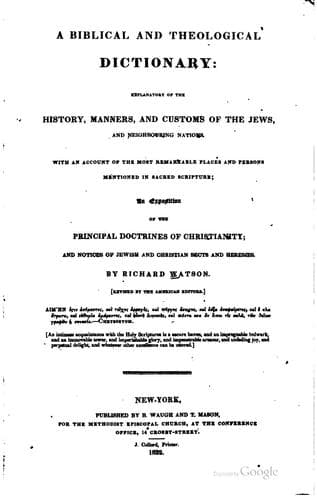
A Biblical and Theological Dictionary: explanatory of the history, manners, and customs of the Jews, and neighbouring nationsWatson, Richard
Religion
A Biblical and Theological Dictionary: explanatory of the history, manners, and customs of the Jews, and neighbouring nations
Watson, Richard
Bible -- Dictionaries; Theology -- Dictionaries
APPELLATIO, an appeal. The Sempronian law secured this privilege to the
Roman citizens, that they could not be capitally convicted, but by the
suffrage of the people; and in whatever provinces they happened to
reside, if the governor showed a disposition to condemn them to death,
to scourge, or deprive them of their property, they had liberty to
appeal from his jurisdiction to the judgment of the people. This law,
which was enacted under the republican form of government, continued in
force under the emperors; so that if any freeman of Rome thought himself
ill used and aggrieved by the presidents in any of the provinces, he
could, by appeal, remove his cause to Rome, to the determination of the
emperor. A number of persons, we are told, were delegated by Augustus,
all of consular rank, to receive the appeals of the people in the
provinces. These observations will explain the nature of St. Paul’s
appeal in the Acts of the Apostles.
APPII FORUM, a place about fifty miles from Rome, near the modern town
of Piperno on the road to Naples. It probably had its name from the
statue of Appius Claudius, a Roman consul, who paved the famous way from
Rome to Capua, and whose statue was set up here. To this place some
Christians from Rome came to meet St. Paul, Acts xxviii, 15.
APPLE TREE, תפוח, Prov. xxv, 11; Cant. ii, 3, 5; vii, 8; viii, 5; Joel
i, 12. As the best apples of Egypt, though ordinary, are brought thither
by sea from Rhodes, and by land from Damascus, we may believe that
Judea, an intermediate country between Egypt and Damascus, has none that
are of any value. Can it be imagined, then, that the apple trees of
which the Prophet Joel speaks, i, 12, and which he mentions among the
things that gave joy to the inhabitants of Judea, were those that we
call by that name? Our translators must surely have been mistaken here,
since the apples which the inhabitants of Judea eat at this day are of
foreign growth, and at the same time but very indifferent.
There are five places, beside this in Joel, in which the word occurs;
and from them we learn that it was thought the noblest of the trees of
the wood, and that its fruit was very sweet or pleasant, Cant. ii, 3; of
the colour of gold, Prov. xxv, 11; extremely fragrant, Cant. vii, 8; and
proper for those to smell that were ready to faint, Cant. ii, 5. We may
be sure that the _taphuach_ was very early known in the holy land, as it
is mentioned in the book of Joshua as having given name to a city of
Manasseh and one of Judah. Several interpreters and critics render פר עץ
הדר, Lev. xxiii, 40, _branches_, or fruit, _of the beautiful tree_; and
understand it of the citron; and it is known that the Jews still make
use of the fruit of this tree at their yearly feast of tabernacles.
Public-domain text, read in full here on John Shaqi.
Reviews
Reviews
No reviews yet
Be the first to share your thoughts on this work.
Elsewhere in the archive
Join the Discussion
Join the discussion
Sign in to leave a comment or review.
Sign InorCreate an account