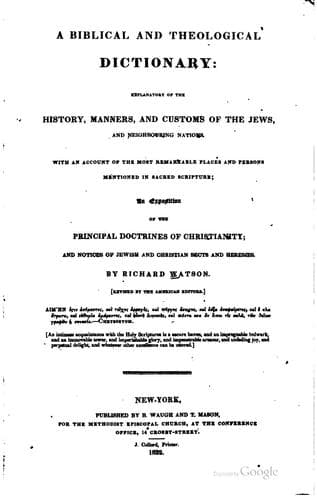
A Biblical and Theological Dictionary: explanatory of the history, manners, and customs of the Jews, and neighbouring nationsWatson, Richard
Religion
A Biblical and Theological Dictionary: explanatory of the history, manners, and customs of the Jews, and neighbouring nations
Watson, Richard
Bible -- Dictionaries; Theology -- Dictionaries
Citron trees are very noble, being large, their leaves beautiful, ever
continuing on the trees, of an exquisite smell, and affording a most
delightful shade. It might well, therefore, be said, “As the citron tree
is among the trees of the wood, so is my beloved among the sons.” This
is a delicate compliment, comparing the fine appearance of the prince,
amid his escort, to the superior beauty with which the citron tree
appears among the ordinary trees of the forest; and the compliment is
heightened by an allusion to the refreshing shade and the exhilarating
fruit.
The exhilarating effects of the fruit are mentioned Cant. ii, 5,
“Comfort me with citrons.” Egmont and Heyman tell us of an Arabian who
was in a great measure brought to himself, when overcome with wine, by
the help of citrons and coffee.
To the manner of serving up these citrons in his court, Solomon seems to
refer, when he says, “A word fitly spoken is like golden citrons in
silver baskets;” whether, as Maimonides supposes, in baskets wrought
with open work, or in salvers curiously chased, it nothing concerns us
to determine; the meaning is, that an excellent saying, suitably
expressed, is as the most acceptable gift in the fairest conveyance. So
the rabbins say, that the tribute of the first ripe fruits was carried
to the temple in silver baskets.
APRIES, a king of Egypt, called in the sacred writings Pharaoh Hophrah,
Jer. xliv, 30. Apries was the son of Psammis, and grandson of Necho, or
Nechao, who waged war against Josiah, king of the Jews. He reigned
twenty-five years, and was long considered as one of the happiest
princes in the world; but having equipped a fleet for the reduction of
the Cyrenians, he lost in this expedition almost the whole of his army.
The Egyptians resolved to make him responsible for this ill success,
rebelled, and pretended that he undertook the war only to get rid of his
subjects, and that he might govern the remainder more absolutely. Apries
deputed Amasis, one of his officers, to suppress the rebellion, and
induce the people to return to their allegiance. But, while Amasis was
haranguing them, one of the multitude placed a diadem about his helmet,
and proclaimed him king. The rest applauded him; and Amasis having
accepted their offer, continued with them, and confirmed them in their
rebellion. Amasis put himself at the head of the rebels, and marched
against Apries, whom he defeated and took prisoner. Amasis treated him
with kindness; but the people were not satisfied till they had taken him
from Amasis and strangled him. Such was the end of Apries, according to
Herodotus. Jeremiah threatened this prince with being delivered into the
hands of his enemies, as he had delivered Zedekiah, king of Judah, into
the hands of Nebuchadnezzar, king of Babylon.
Public-domain text, read in full here on John Shaqi.
Reviews
Reviews
No reviews yet
Be the first to share your thoughts on this work.
Elsewhere in the archive
Join the Discussion
Join the discussion
Sign in to leave a comment or review.
Sign InorCreate an account