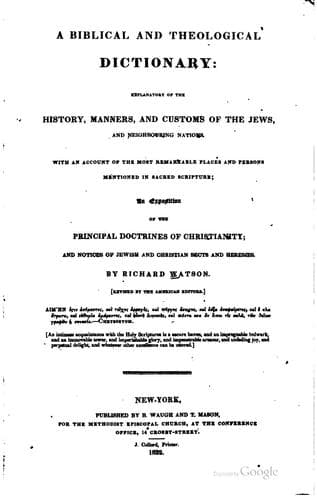
A Biblical and Theological Dictionary: explanatory of the history, manners, and customs of the Jews, and neighbouring nationsWatson, Richard
Religion
A Biblical and Theological Dictionary: explanatory of the history, manners, and customs of the Jews, and neighbouring nations
Watson, Richard
Bible -- Dictionaries; Theology -- Dictionaries
ARABIA. A vast country of Asia, extending one thousand five hundred
miles from north to south, and one thousand two hundred from east to
west; containing a surface equal to four times that of France. The near
approach of the Euphrates to the Mediterranean constitutes it a
peninsula, the largest in the world. It is called Jezirat-el-Arab by the
Arabs; and by the Persians and Turks, Arebistan. This is one of the most
interesting countries on the face of the earth. It has, in agreement
with prophecy, never been subdued; and its inhabitants, at once
pastoral, commercial, and warlike, are the same wild, wandering people
as the immediate descendants of their great ancestor Ishmael are
represented to have been.
Arabia, or at least the eastern and northern parts of it, were first
peopled by some of the numerous families of Cush, who appear to have
extended themselves, or to have given their name as the land of Cush, or
Asiatic Ethiopia, to all the country from the Indus on the east, to the
borders of Egypt on the west, and from Armenia on the north to Arabia
Deserta on the south. By these Cushites, whose first plantations were on
both sides of the Euphrates and Gulf of Persia, and who were the first
that traversed the desert of Arabia, the earliest commercial
communications were established between the east and the west. But of
their Arabian territory, and of the occupation dependent on it, they
were deprived by the sons of Abraham, Ishmael, and Midian; by whom they
were obliterated in this country as a distinct race, either by
superiority of numbers after mingling with them, or by obliging them to
recede altogether to their more eastern possessions, or over the Gulf of
Arabia into Africa. From this time, that is, about five hundred and
fifty years after the flood, we read only of Ishmaelites and Midianites
as the shepherds and carriers of the deserts; who also appear to have
been intermingled, and to have shared both the territory and the
traffic, as the traders who bought Joseph are called by both names, and
the same are probably referred to by Jeremiah, xxv, as “the mingled
people that dwell in the desert.” But Ishmael maintained the
superiority, and succeeded in giving his name to the whole people.
Arabia, it is well known, is divided by geographers into three separate
regions, called Arabia Petræa, Arabia Deserta, and Arabia Felix.
Public-domain text, read in full here on John Shaqi.
Reviews
Reviews
No reviews yet
Be the first to share your thoughts on this work.
Elsewhere in the archive
Join the Discussion
Join the discussion
Sign in to leave a comment or review.
Sign InorCreate an account