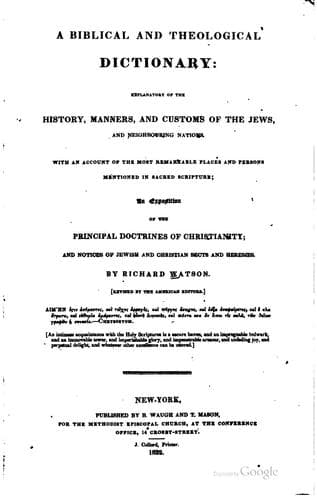
A Biblical and Theological Dictionary: explanatory of the history, manners, and customs of the Jews, and neighbouring nationsWatson, Richard
Religion
A Biblical and Theological Dictionary: explanatory of the history, manners, and customs of the Jews, and neighbouring nations
Watson, Richard
Bible -- Dictionaries; Theology -- Dictionaries
Apries had made a league with Zedekiah, and promised him assistance,
Ezek. xvii, 15. Zedekiah, therefore, relying on his forces, revolted
from Nebuchadnezzar, in the year of the world 3414, and before Jesus
Christ 590. Early in the year following, Nebuchadnezzar marched against
Hezekiah; but as other nations of Syria had shaken off their obedience,
he first reduced them to their duty, and toward the end of the year
besieged Jerusalem, 2 Kings xxv, 5; 2 Chron. xxxvi, 17; Jer. xxxix, 1;
lii, 4. Zedekiah defended himself in Jerusalem, long and obstinately,
that he might give time to Pharaoh Hophrah, or Apries, to come to his
assistance. Apries advanced with a powerful army; and the king of
Babylon raised the siege, and marched to meet him. But Apries not daring
to hazard a battle against the Chaldeans, retreated into Egypt, and
abandoned Zedekiah. Ezekiel reproaches Egypt severely with this
baseness, and says that it had been a staff of reed to the house of
Israel, and an occasion of falling; for when they took hold of it by the
hand, it broke and rent all their shoulder. He therefore prophesies that
Egypt should be reduced to a solitude, and that God would send against
it the sword, which would destroy in it man and beast, Ezek. xxix. This
was afterward accomplished, first, in the time of Apries; and secondly,
in the conquest of Egypt by the Persians.
AQUILA. This person was a native of Pontus in Asia Minor, and was
converted by St. Paul, together with his wife Priscilla, to the
Christian religion. As Aquila was by trade a tentmaker, Acts xviii, 2,
3, as St. Paul was, the Apostle lodged and wrought with him at Corinth.
Aquila came thither, not long before, from Italy, being obliged to leave
Rome upon the edict which the emperor Claudius had published, banishing
the Jews from that city. St. Paul afterward quitted Aquila’s house, and
abode with Justus, near the Jewish synagogue at Corinth; probably, as
Calmet thinks, because Aquila was a converted Jew, and Justus was a
convert from Paganism, that in this case the Gentiles might come and
hear him with more liberty. When the Apostle left Corinth, Aquila and
Priscilla accompanied him as far as Ephesus, where he left them with
that church while he pursued his journey to Jerusalem. They rendered him
great service in that city, so far as to expose their own lives to
preserve his. They had returned to Rome when St. Paul wrote his Epistle
to the Romans, xvi, 4, wherein he salutes them with great kindness.
Lastly, they were come back to Ephesus again, when St. Paul wrote his
Second Epistle to Timothy, iv, 19, wherein he desires him to salute them
in his name. What became of them after this time is not known.
AR, the capital city of the Moabites, situated in the hills on the south
of the river Arnon. This city was likewise called Rabbah or Rabbath
Moab, to distinguish it from the Ammonite Rabbah. It was afterward
called by the Greeks Areopolis; and is at present termed El-Rabba. See
MOAB.
Public-domain text, read in full here on John Shaqi.
Reviews
Reviews
No reviews yet
Be the first to share your thoughts on this work.
Elsewhere in the archive
Join the Discussion
Join the discussion
Sign in to leave a comment or review.
Sign InorCreate an account