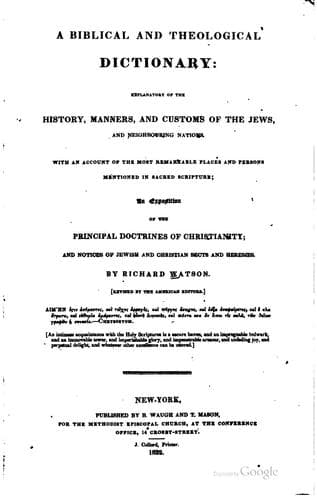
A Biblical and Theological Dictionary: explanatory of the history, manners, and customs of the Jews, and neighbouring nationsWatson, Richard
Religion
A Biblical and Theological Dictionary: explanatory of the history, manners, and customs of the Jews, and neighbouring nations
Watson, Richard
Bible -- Dictionaries; Theology -- Dictionaries
The third region, or Arabia Felix, so denominated from the happier
condition of its soil and climate, occupies the southern part of the
Arabian peninsula. It is bounded on the north by the two other divisions
of the country; on the south and south-east by the Indian Ocean; on the
east by part of the same ocean and the Persian Gulf; and on the west by
the Red Sea. This division is subdivided into the kingdoms or provinces
of Yemen, at the southern extremity of the peninsula; Hejaz, on the
north of the former, and toward the Red Sea; Nejed, in the central
region; and Hadramant and Oman, on the shores of the Indian Ocean. The
four latter subdivisions partake of much of the character of the other
greater divisions of the country, though of a more varied surface, and
with a larger portion capable of cultivation. But Yemen seems to belong
to another country and climate. It is very mountainous, is well watered
with rains and springs, and is blessed with an abundant produce in corn
and fruits, and especially in coffee, of which vast quantities are
exported. In this division were the ancient cities of Nysa, Musa or
Moosa, and Aden. This is also supposed to have been the country of the
queen of Sheba. In Hejaz are the celebrated cities of Mecca and Medina.
Arabia Felix is inhabited by a people who claim Jotkan for their father,
and so trace their descent direct from Shem, instead of Abraham and Ham.
They are indeed a totally different people from those inhabiting the
other quarters, and pride themselves on being the only pure and unmixed
Arabs. Instead of being shepherds and robbers, they are fixed in towns
and cities; and live by agriculture and commerce, chiefly maritime. Here
were the people who were found by the Greeks of Egypt enjoying an entire
monopoly of the trade with the east, and possessing a high degree of
wealth and consequent refinement. It was here, in the ports of Sabæa,
that the spices, muslins, and precious stones of India, were for many
ages obtained by the Greek traders of Egypt, before they had acquired
skill or courage sufficient to pass the straits of the Red Sea; which
were long considered by the nations of Europe to be the produce of
Arabia itself. These articles, before the invention of shipping, or the
establishment of a maritime intercourse, were conveyed across the
deserts by the Cushite, Ishmaelite, and Midianite carriers. It was the
produce partly of India, and partly of Arabia, which the travelling
merchants, to whom Joseph was sold, were carrying into Egypt. The balm
and myrrh were probably Arabian, as they are still the produce of the
same country; but the spicery was undoubtedly brought farther from the
east. These circumstances are adverted to, to show how extensive was the
communication, in which the Arabians formed the principal link: and that
in the earliest ages of which we have any account, in those of Joseph,
of Moses, of Isaiah, and of Ezekiel, “the mingled people” inhabiting the
Public-domain text, read in full here on John Shaqi.
Reviews
Reviews
No reviews yet
Be the first to share your thoughts on this work.
Elsewhere in the archive
Join the Discussion
Join the discussion
Sign in to leave a comment or review.
Sign InorCreate an account