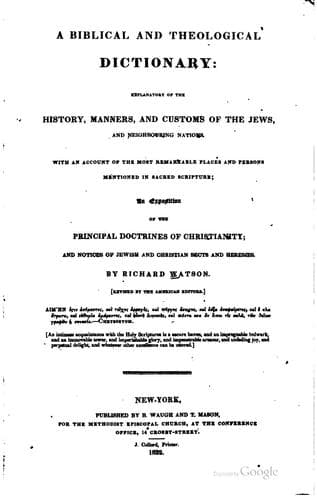
A Biblical and Theological Dictionary: explanatory of the history, manners, and customs of the Jews, and neighbouring nationsWatson, Richard
Religion
A Biblical and Theological Dictionary: explanatory of the history, manners, and customs of the Jews, and neighbouring nations
Watson, Richard
Bible -- Dictionaries; Theology -- Dictionaries
vast Arabian deserts, the Cushites, Ishmaelites, and Midianites, were
the chief agents in that commercial intercourse which has, from the most
remote period of antiquity, subsisted between the extreme east and west.
And although the current of trade is now turned, caravans of merchants,
the descendants of these people, may still be found traversing the same
deserts, conveying the same articles, and in the same manner as
described by Moses!
The singular and important fact that Arabia has never been conquered,
has already been cursorily adverted to. But Mr. Gibbon, unwilling to
pass by an opportunity of cavilling at revelation, says, “The perpetual
independence of the Arabs has been the theme of praise among strangers
and natives; and the arts of controversy transform this singular event
into a prophecy and a miracle in favour of the posterity of Ishmael.
Some exceptions, that can neither be dissembled nor eluded, render this
mode of reasoning as indiscreet as it is superfluous. The kingdom of
Yemen has been successively subdued by the Abyssinians, the Persians,
the Sultans of Egypt, and the Turks; the holy cities of Mecca and Medina
have repeatedly bowed under a Scythian tyrant; and the Roman province of
Arabia embraced the peculiar wilderness in which Ishmael and his sons
must have pitched their tents in the face of their brethren.” But this
learned writer has, with a peculiar infelicity, annulled his own
argument; and we have only to follow on the above passage, to obtain a
complete refutation of the unworthy position with which it begins: “Yet
these exceptions,” says Mr. Gibbon, “are temporary or local; the body of
the nation has escaped the yoke of the most powerful monarchies: the
arms of Sesostris and Cyrus, of Pompey, and Trajan, could never achieve
the conquest of Arabia; the present sovereign of the Turks may exercise
a shadow of jurisdiction, but his pride is reduced to solicit the
friendship of a people whom it is dangerous to provoke, and fruitless to
attack. The obvious causes of their freedom are inscribed on the
character and country of the Arabs. Many ages before Mohammed, their
intrepid valour had been severely felt by their neighbours, in offensive
and defensive war. The patient and active virtues of a soldier are
insensibly nursed in the habits and discipline of a pastoral life. The
care of the sheep and camels is abandoned to the women of the tribe; but
the martial youth, under the banner of the emir, is ever on horseback
and in the field, to practise the exercise of the bow, the javelin, and
the scimitar. The long memory of their independence is the firmest
pledge of its perpetuity; and succeeding generations are animated to
prove their descent, and to maintain their inheritance. Their domestic
feuds are suspended on the approach of a common enemy; and in their last
hostilities against the Turks, the caravan of Mecca was attacked and
pillaged by four score thousand of the confederates. When they advance
Public-domain text, read in full here on John Shaqi.
Reviews
Reviews
No reviews yet
Be the first to share your thoughts on this work.
Elsewhere in the archive
Join the Discussion
Join the discussion
Sign in to leave a comment or review.
Sign InorCreate an account