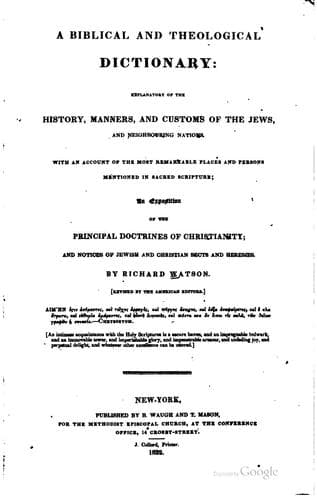
A Biblical and Theological Dictionary: explanatory of the history, manners, and customs of the Jews, and neighbouring nationsWatson, Richard
Religion
A Biblical and Theological Dictionary: explanatory of the history, manners, and customs of the Jews, and neighbouring nations
Watson, Richard
Bible -- Dictionaries; Theology -- Dictionaries
The Arabian tribes were confounded by the Greeks and Romans under the
indiscriminate appellation of Saracens; a name whose etymology has been
variously, but never satisfactorily, explained. This was their general
name when Mohammed appeared in the beginning of the seventh century.
Their religion at this time was Sabianism, or the worship of the sun,
moon, &c; variously transformed by the different tribes, and
intermingled with some Jewish and Christian maxims and traditions. The
tribes themselves were generally at variance, from some hereditary and
implacable animosities; and their only warfare consisted in desultory
skirmishes arising out of these feuds, and in their predatory
excursions, where superiority of numbers rendered courage of less value
than activity and vigilance. Yet of such materials Mohammed constructed
a mighty empire; converted the relapsed Ishmaelites into good Musselmen;
united the jarring tribes under one banner; supplied what was wanting in
personal courage by the ardour of religious zeal; and out of a banditti,
little known and little feared beyond their own deserts, raised an armed
multitude, which proved the scourge of the world.
Mohammed was born in the year 569, of the noble tribe of the Koreish,
and descended, according to eastern historians, in a direct line from
Ishmael. His person is represented as beautiful, his manners engaging,
and his eloquence powerful; but he was illiterate, like the rest of his
countrymen, and indebted to a Jewish or Christian scribe for penning his
Koran. Whatever the views of Mohammed might have been in the earlier
part of his life, it was not till the fortieth year of his age that he
avowed his mission as the Apostle of God: when so little credit did he
gain for his pretensions, that in the first three years he could only
number fourteen converts; and even at the end of ten years his labours
and his friends were alike confined within the walls of Mecca, when the
designs of his enemies compelled him to fly to Medina, where he was
favourably received by a party of the most considerable inhabitants, who
had recently imbibed his doctrines at Mecca. This flight, or _Hegira_,
was made the Mohammedan æra, from which time is computed, and
corresponds with the 16th of July, 622, of the Christian æra. Mohammed
now found himself sufficiently powerful to throw aside all reserve;
declared that he was commanded to compel unbelievers by the sword to
receive the faith of one God, and his prophet Mohammed; and confirming
his credulous followers by the threats of eternal pain on the one hand,
and the allurements of a sensual paradise on the other, he had, before
his death, which happened in the year 632, gained over the whole of
Arabia to his imposture. His death threw a temporary gloom over his
cause, and the disunion of his followers threatened its extinction. Any
other empire placed in the same circumstances would have crumbled to
pieces; but the Arabs felt their power; they revered their founder as
Public-domain text, read in full here on John Shaqi.
Reviews
Reviews
No reviews yet
Be the first to share your thoughts on this work.
Elsewhere in the archive
Join the Discussion
Join the discussion
Sign in to leave a comment or review.
Sign InorCreate an account