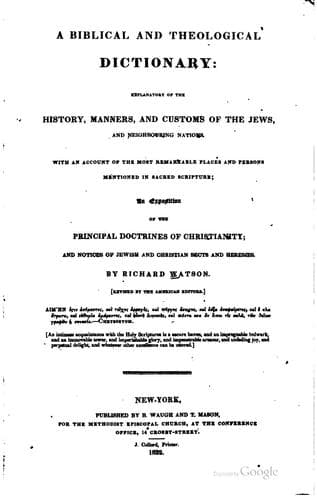
A Biblical and Theological Dictionary: explanatory of the history, manners, and customs of the Jews, and neighbouring nationsWatson, Richard
Religion
A Biblical and Theological Dictionary: explanatory of the history, manners, and customs of the Jews, and neighbouring nations
Watson, Richard
Bible -- Dictionaries; Theology -- Dictionaries
the chosen prophet of God; and their ardent temperament, animated by a
religious enthusiasm, gave an earnest of future success, and encouraged
the zeal or the ambition of their leaders. The succession, after some
bloodshed, was settled, and unnumbered hordes of barbarians were ready
to carry into execution the sanguinary dictates of their prophet; and,
with “the Koran, tribute, or death,” as their motto, to invade the
countries of the infidels. During the whole of the succeeding century,
their rapid career was unchecked; the disciplined armies of the Greeks
and Romans were unable to stand against them; the Christian churches of
Asia and Africa were annihilated; and from India to the Atlantic,
through Persia, Arabia, Syria, Palestine, Asia Minor, Egypt, with the
whole of northern Africa, Spain, and part of France, the impostor was
acknowledged. Constantinople was besieged; Rome itself was plundered;
and nothing less than the subjection of the whole Christian world was
meditated on the one hand and tremblingly expected on the other.
All this was wonderful; but the avenging justice of an incensed Deity,
and the sure word of prophecy, relieve our astonishment. It was to
punish an apostate race, that the Saracen locusts were let loose upon
the earth; and the countries which they were permitted to ravage were
those in which the pure light of revelation had been most abused. The
eastern church was sunk in gross idolatry; vice and wickedness prevailed
in their worst forms; and those who still called themselves Christians
trusted more to images, relics, altars, austerities, and pilgrimages,
than to a crucified Saviour.
About a hundred and eighty years from the foundation of Bagdad, during
which period the power of the Saracens had gradually declined, a
dreadful reaction took place in the conquered countries. The Persians on
the east, and the Greeks on the west, were simultaneously roused from
their long thraldom, and, assisted by the Turks, who, issuing from the
plains of Tartary, now for the first time made their appearance in the
east, extinguished the power of the caliphate, and virtually put an end
to the Arabian monarchy in the year 936. A succession of nominal caliphs
continued to the year 1258: but the provinces were lost; their power was
confined to the walls of their capital; and they were in real subjection
to the Turks and the Persians until the above year, when Mostacem, the
last of the Abbassides, was dethroned and murdered by Holagou, or
Hulaku, the Tartar, the grandson of Zingis. This event, although it
terminated the foreign dominion of the Arabians, left their native
independence untouched. They were no longer, indeed, the masters of the
finest parts of the three great divisions of the ancient world: their
work was finished; and returning to the state in which Mohammed found
them three centuries before, with the exception of the change in their
religion, they remained, and still remain, the unconquered rovers of the
desert.
Public-domain text, read in full here on John Shaqi.
Reviews
Reviews
No reviews yet
Be the first to share your thoughts on this work.
Elsewhere in the archive
Join the Discussion
Join the discussion
Sign in to leave a comment or review.
Sign InorCreate an account