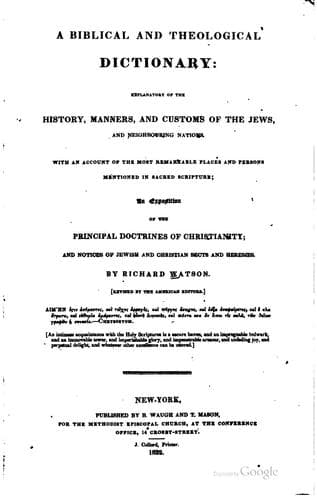
A Biblical and Theological Dictionary: explanatory of the history, manners, and customs of the Jews, and neighbouring nationsWatson, Richard
Religion
A Biblical and Theological Dictionary: explanatory of the history, manners, and customs of the Jews, and neighbouring nations
Watson, Richard
Bible -- Dictionaries; Theology -- Dictionaries
My eye, not able to rest for any
length of time upon the blinding glory of its summits, wandered down the
apparently interminable sides, till I could no longer trace their vast
lines in the mists of the horizon; when an inexpressible impulse,
immediately carrying my eye upward again, refixed my gaze upon the awful
glare of Ararat; and this bewildered sensibility of sight being answered
by a similar feeling in the mind, for some moments I was lost in a
strange suspension of the powers of thought.”
The separate peaks are called Great and Little Ararat, and the space
between them is about seven miles. “These inaccessible summits,”
continues Sir R. K. Porter, “have never been trodden by the foot of man
since the days of Noah, if even then; for my idea is, that the ark
rested in the space between these heads, and not on the top of either.
Various attempts have been made in different ages to ascend these
tremendous mountain-pyramids, but in vain: their form, snows, and
glaciers, are insurmountable obstacles: the distance being so great from
the commencement of the icy region to the highest points, cold alone
would be the destruction of any person who should have the hardihood to
persevere. On viewing mount Ararat from the northern side of the plain,
its two heads are separated by a wide cleft, or rather glen, in the body
of the mountain. The rocky side of the greater head runs almost
perpendicularly down to the north-east, while the lesser head rises from
the sloping bottom of the cleft, in a perfectly conical shape. Both
heads are covered with snow. The form of the greater is similar to the
less, only broader and rounder at the top; and shows to the north-west a
broken and abrupt front, opening, about half way down, into a stupendous
chasm, deep, rocky, and peculiarly black. At that part of the mountain,
the hollow of the chasm receives an interruption from the projection of
minor mountains, which start from the sides of Ararat like branches from
the root of a tree, and run along, in undulating progression, till lost
in the distant vapours of the plain.” Dr. Shuckford argues that the true
Ararat lies among the mountains of the north of India; but Mr. Faber has
answered his reasoning, and proved by a comparison of geographical
notices incidentally mentioned in the Old Testament, that the Ararat of
Armenia is the true Ararat.
Public-domain text, read in full here on John Shaqi.
Reviews
Reviews
No reviews yet
Be the first to share your thoughts on this work.
Elsewhere in the archive
Join the Discussion
Join the discussion
Sign in to leave a comment or review.
Sign InorCreate an account