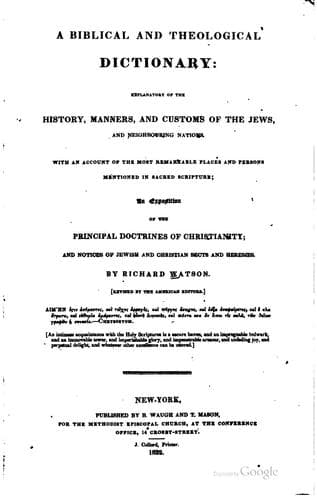
A Biblical and Theological Dictionary: explanatory of the history, manners, and customs of the Jews, and neighbouring nationsWatson, Richard
Religion
A Biblical and Theological Dictionary: explanatory of the history, manners, and customs of the Jews, and neighbouring nations
Watson, Richard
Bible -- Dictionaries; Theology -- Dictionaries
The mountain which has still the name of Ararat, has retained it through
all ages. Tournefort has particularly described it, and from his account
it seems to consist chiefly of freestone, or calcareous sandstone. It is
a detached mountain in form of a sugar loaf, in the midst of a very
extensive plain, consisting of two summits; the lesser, more sharp and
pointed; the higher, which is that of the ark, lies north-west of it,
and raises its head far above the neighbouring mountains, and is covered
with perpetual snow. When the air is clear, it does not appear to be
above two leagues from Erivan, and may be seen at the distance of four
or five days’ journey. Its being visible at such a distance, however, is
ascribed not so much to its height, as to its lonely situation, in a
large plain, and upon the most elevated part of the country. The ascent
is difficult and fatiguing. Tournefort attempted it; and, after a whole
day’s toil, he was obliged, by the snow and intense cold, to return
without accomplishing his design, though in the middle of summer. On the
side of the mountain that looks toward Erivan, is a prodigious
precipice, very deep, with perpendicular sides, and of a rough, black
appearance, as if tinged with smoke.
The summit of Ararat has never been reached, though several attempts
have been made; and if the ark rested on the summit, it is certain that
those who have spoken of its fragments being seen there in different
ages, must have been imposed upon. It is, however, not necessary to
suppose that the ark rested upon either of its tops; and that spot would
certainly be chosen which would afford the greatest facility of descent.
Sir Robert Ker Porter is among the modern travellers who have given us
an account of this celebrated mountain:--“As the vale opened beneath us
in our descent, my whole attention became absorbed in the view before
me. A vast plain, peopled with countless villages; the towers and spires
of the churches of Eitch-mai-adzen, arising from amidst them; the
glittering waters of the Araxes, flowing through the fresh green of the
vale; and the subordinate range of mountains, skirting the base of the
awful monument of the antediluvian world. It seemed to stand a
stupendous link in the history of man, uniting the two races of men
before and after the flood. But it was not until we had arrived upon the
flat plain, that I beheld Ararat in all its amplitude of grandeur. From
the spot on which I stood, it appeared as if the hugest mountains of the
world had been piled upon each other, to form this one sublime immensity
of earth, and rock, and snow. The icy peaks of its double heads rose
majestically into the clear and cloudless heavens; the sun blazed bright
upon them; and the reflection sent forth a dazzling radiance, equal to
other suns. This point of the view united the utmost grandeur of plain
and height. But the feelings I experienced while looking on the
mountain, are hardly to be described.
Public-domain text, read in full here on John Shaqi.
Reviews
Reviews
No reviews yet
Be the first to share your thoughts on this work.
Elsewhere in the archive
Join the Discussion
Join the discussion
Sign in to leave a comment or review.
Sign InorCreate an account