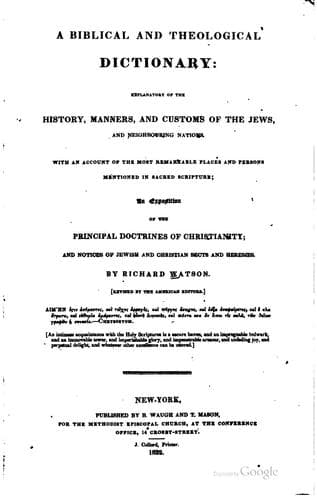
A Biblical and Theological Dictionary: explanatory of the history, manners, and customs of the Jews, and neighbouring nationsWatson, Richard
Religion
A Biblical and Theological Dictionary: explanatory of the history, manners, and customs of the Jews, and neighbouring nations
Watson, Richard
Bible -- Dictionaries; Theology -- Dictionaries
ARCHITRICLINUS, ἀρχιτρίκλινος, generally translated steward, signifies
rather the _master_ or _superintendent of the feast_; “one,” says
Gaudentius, “who is the husband’s friend, and commissioned to conduct
the order and economy of the feast.” He gave directions to the servants,
superintended every thing, commanded the tables to be covered, or to be
cleared of the dishes, as he thought proper: whence his name, as
regulator of the triclinium, or festive board. He also tasted the wine,
and distributed it to the guests. The author of Ecclesiasticus thus
describes this office, xxxii, 1, 2: “If thou be made the master of a
feast, lift not thyself up, but be among them as one of the rest: take
diligent care of them, and so sit down. And when thou hast done all thy
office, take thy place, that thou mayest be merry with them, and receive
a crown for the well ordering of the feast.” This office is mentioned,
John ii, 8, 9, upon which Theophylact remarks: “That no one might
suspect that their taste was vitiated by having drunk to excess, so as
not to know water from wine, our Saviour orders it to be first carried
to the governor of the feast, who _certainly_ was sober; for those who
on such occasions are intrusted with this office, observe the strictest
sobriety, that they may be able properly to regulate the whole.”
AREOPAGUS, the high court at Athens, famed for the justice of its
decisions; and so called, because it sat on a hill of the same name, or
in the suburbs of the city, dedicated to Mars, the god of war, as the
city was to Minerva, his sister. St. Paul, Acts xvii, 19, &c, having
preached at Athens, was carried before the Areopagites, as “a setter
forth of strange gods.” On this occasion he delivered that fine sermon
which is in substance recorded in Acts xvii. Dionysius, one of the
judges, was converted; and the Apostle was dismissed without any farther
trouble.
ARGOB, a canton lying beyond Jordan, in the half tribe of Manasseh, and
in the country of Bashan, one of the most fruitful on the other side of
Jordan. In the region of Argob there were sixty cities, called
Bashan-havoth-Jair, which had very high walls and strong gates, without
reckoning many villages and hamlets, which were not inclosed, Deut. iii,
4–14; 1 Kings iv, 13. But Argob was more peculiarly the name of the
capital city of the region of Argob, which Eusebius says was fifteen
miles west of Gerara.
Public-domain text, read in full here on John Shaqi.
Reviews
Reviews
No reviews yet
Be the first to share your thoughts on this work.
Elsewhere in the archive
Join the Discussion
Join the discussion
Sign in to leave a comment or review.
Sign InorCreate an account