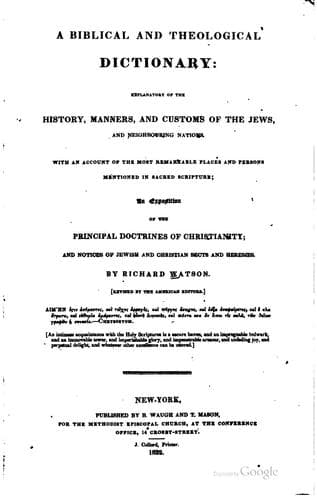
A Biblical and Theological Dictionary: explanatory of the history, manners, and customs of the Jews, and neighbouring nationsWatson, Richard
Religion
A Biblical and Theological Dictionary: explanatory of the history, manners, and customs of the Jews, and neighbouring nations
Watson, Richard
Bible -- Dictionaries; Theology -- Dictionaries
ARIANS, this ancient sect, was unquestionably so called from Arius, a
presbyter of Alexandria, in the early part of the fourth century. It
is said that he aspired to episcopal honours; and after the death of
Achilles, in A. D. 313, felt not a little chagrined that Alexander
should be preferred before him. Whether this circumstance had any
influence on his opinions, it is impossible to say; but one day, when
his rival (Alexander) had been addressing the clergy in favour of the
orthodox doctrine, and maintaining, in strong and pointed language,
“that the Son of God was co-eternal, co-essential, and co-equal with
the Father,” Arius considered this as a species of Sabellianism, and
ventured to say, that it was inconsistent and impossible, since the
Father, who begat, must be before the Son, who was begotten: the
latter, therefore, could not be absolutely eternal. Alexander at first
admonished Arius, and endeavoured to convince him of his error; but
without effect, except that he became the more bold in contradiction.
Some of the clergy thought their bishop too forbearing, and it is
possible he felt his inferiority of talent; for Arius was a man of
accomplished learning, and commanding eloquence; venerable in person,
and fascinating in address. At length Alexander was roused, and
attempted to silence Arius by his authority; but this not succeeding,
as the latter was bold and pertinacious, Alexander, about the year
320, called a council of his clergy, by whom the reputed heretic was
deposed and excommunicated. Arius now retired into Palestine, where
his talents and address soon made a number of converts; and among the
rest, the celebrated Eusebius, bishop of Nicomedia, and other bishops
and clergy of those parts, who assembled in council, and received the
excommunicated presbyter into their communion. Eusebius also, having
great interest with Constantia, the sister of Constantine, and wife of
Licinius, recommended Arius to her protection and patronage; through
which, and by his own eloquent letters to the clergy in various parts,
his system spread with great rapidity, and to a vast extent. The
emperor Constantine, who had no great skill in these matters, was
grieved to see the Christian church (but just escaped from the red
dragon of persecution) thus torn by intestine animosity and
dissensions; he therefore determined to summon a general council of
the clergy, which met at Nice, A. D. 325, and contained more than 300
bishops. Constantine attended in person, and strongly recommended
peace and unanimity. Athanasius was the chief opponent of the Arians.
Both parties were willing to subscribe to the language of the
Scriptures, but each insisted on interpreting for themselves. “Did the
Trinitarians,” says Mr. Milner, “assert that Christ was God? The
Arians allowed it, but in the same sense as holy men and angels are
styled gods in Scripture. Did they affirm that he was truly God? The
others allowed that he was made so by God. Did they affirm that the
Public-domain text, read in full here on John Shaqi.
Reviews
Reviews
No reviews yet
Be the first to share your thoughts on this work.
Elsewhere in the archive
Join the Discussion
Join the discussion
Sign in to leave a comment or review.
Sign InorCreate an account