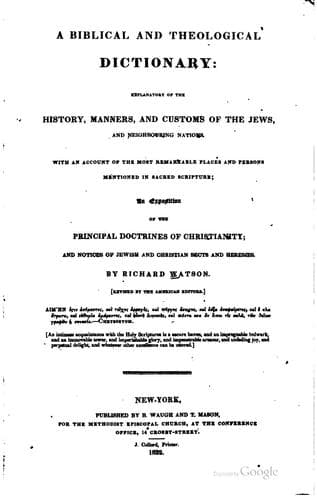
A Biblical and Theological Dictionary: explanatory of the history, manners, and customs of the Jews, and neighbouring nationsWatson, Richard
Religion
A Biblical and Theological Dictionary: explanatory of the history, manners, and customs of the Jews, and neighbouring nations
Watson, Richard
Bible -- Dictionaries; Theology -- Dictionaries
Plutarch mentions the Noachic dove, and its being sent out of the
ark. Lucian speaks of Deucalion’s going forth from the ark, and raising
an altar to God. The priests of Ammonia had a custom, at particular
seasons, of carrying in procession a boat, in which was an oracular
shrine, held in great veneration: and this custom of carrying the deity
in an ark or boat was in use also among the Egyptians. Bishop Pococke
has preserved three specimens of ancient sculpture, in which this
ceremony is displayed. They were very ancient, and found by him in Upper
Egypt. The ship of Isis referred to the ark, and its name, “Baris,” was
that of the mountain corresponding to Ararat in Armenia. Bryant finds
reference to the ark in the temples of the serpent worship, called
_Dracontia_; and also in that of Sesostris, fashioned after the model of
the ark, in commemoration of which it was built, and consecrated to
Osiris at Theba; and he conjectures that the city, said to be one of the
most ancient in Egypt, as well as the province, was denominated from it,
Theba being the appellation of the ark. In other countries, as well as
in Egypt, an ark, or ship, was introduced in their mysteries, and often
carried about in the seasons of their festivals. He finds, also, in the
story of the Argonauts several particulars, that are thought to refer to
the ark of Noah. As many cities, not in Egypt only and Bœotia, but in
Cilicia, Ionia, Attica, Phthiotis, Cataonia, Syria, and Italy, were
called Theba; so likewise the city Apamea was denominated _Cibotus_,
from κιϐωτος, in memory of the ark, and of the history connected with
it. The ark, according to the traditions of the Gentile world, was
prophetic; and was regarded as a kind of temple or residence of the
deity. It comprehended all mankind, within the circle of eight persons,
who were thought to be so highly favoured of Heaven that they at last
were reputed to be deities. Hence in the ancient mythology of Egypt,
there were precisely eight gods; and the ark was esteemed an emblem of
the system of the heavens. The principal terms by which the ancients
distinguished the ark were Theba, Baris, Arguz, Aren, Arene, Arni,
Laris, Boutas, Bœotus, and Cibotus; and out of these they formed
different personages. See DELUGE.
Public-domain text, read in full here on John Shaqi.
Reviews
Reviews
No reviews yet
Be the first to share your thoughts on this work.
Elsewhere in the archive
Join the Discussion
Join the discussion
Sign in to leave a comment or review.
Sign InorCreate an account