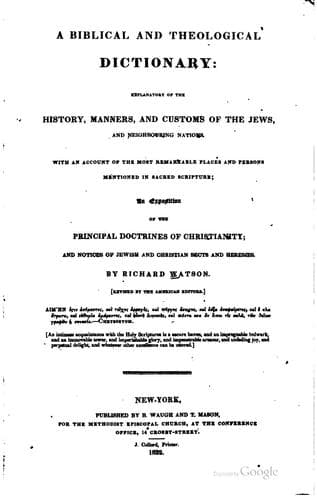
A Biblical and Theological Dictionary: explanatory of the history, manners, and customs of the Jews, and neighbouring nationsWatson, Richard
Religion
A Biblical and Theological Dictionary: explanatory of the history, manners, and customs of the Jews, and neighbouring nations
Watson, Richard
Bible -- Dictionaries; Theology -- Dictionaries
Whether Noah was commanded to bring with him, into the ark, a pair of
_all_ living creatures, zoologically and numerically considered, has
been doubted. During the long period between the creation and the flood,
animals must have spread themselves over a great part of the
antediluvian earth, and certain animals would, as now, probably become
indigenous to certain climates. The pairs saved must therefore, if all
the kinds were included, have travelled from immense distances. But of
such marches no intimation is given in the history; and this seems to
render it probable that the animals which Noah was “_to bring with him_”
into the ark, were the animals clean and unclean of the country in which
he dwelt, and which, from the capacity of the ark, must have been in
great variety and number. The terms used, it is true, are universal; and
it is satisfactory to know, that if taken in the largest sense there was
ample accommodation in the ark. Nevertheless, universal terms in
Scripture are not always to be taken mathematically, and in the vision
of Peter, the phrase ϖάντα τὰ τετράποδα τῆς γῆς,--_all the four-footed
beasts of the earth_, must be understood of _varii generis quadrupedes_,
as Schleusner paraphrases it. Thus we may easily account for the exuviæ
of animals, whose species no longer exist, which have been discovered in
various places. The number of such extinct species probably has been
greatly over-rated by Cuvier; but of the fact, to a considerable extent,
there can be no doubt. It is also to be observed that the presumptive
evidence of the truth of the fact of the preparation of such a vessel,
and of the supernatural circumstances which attended it, is exceedingly
strong. It is, in truth, the only solution of a difficulty which has no
other explanation; for as a universal deluge is confirmed by the general
history of the world, and by a variety of existing facts and monuments,
such a structure as the ark, for the preservation and sustenance of
various animals, seems to have been absolutely necessary; for as we can
trace up the first imperfect rudiments of the art of ship building among
the Greeks, there could be no ships before the flood; and, consequently,
no animals could have been saved. Nay, it is highly improbable that even
men and domestic animals could be saved, not to mention wild beasts,
serpents, &c, though we should admit that the antediluvians had
shipping, unless we should suppose, also, that they had a divine
intimation respecting the flood, such as Moses relates; but this would
be to give up the cause of infidelity. Mr. Bryant has collected a
variety of ancient historical relations, which show that some records
concerning the ark had been preserved among most nations of the world,
and in the general system of Gentile mythology. Abydenus, with whom all
the eastern writers concur, informs us that the place of descent from
the ark was Armenia; and that its remains had been preserved for a long
time.
Public-domain text, read in full here on John Shaqi.
Reviews
Reviews
No reviews yet
Be the first to share your thoughts on this work.
Elsewhere in the archive
Join the Discussion
Join the discussion
Sign in to leave a comment or review.
Sign InorCreate an account