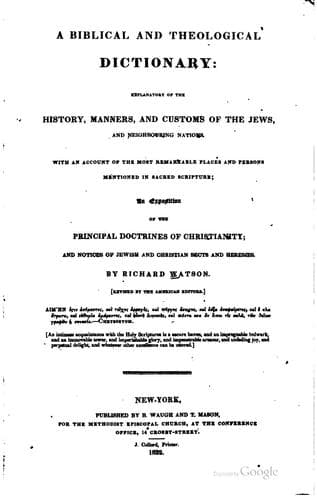
A Biblical and Theological Dictionary: explanatory of the history, manners, and customs of the Jews, and neighbouring nationsWatson, Richard
Religion
A Biblical and Theological Dictionary: explanatory of the history, manners, and customs of the Jews, and neighbouring nations
Watson, Richard
Bible -- Dictionaries; Theology -- Dictionaries
What became of the ark at the destruction of the
temple by Nebuchadnezzar, is a dispute among the rabbins. Had it been
carried to Babylon with the other vessels of the temple, it would, in
all probability, have been brought back with them at the close of the
captivity. But that this was not the case, is agreed on all hands;
whence it is probable that it was destroyed with the temple.
The ark of the covenant was, as it were, the centre of worship to all
those of the Hebrew nation who served God according to the Levitical
law; and not only in the temple, when they came thither to worship, but
every where else in their dispersions through the whole world; whenever
they prayed, they turned their faces toward the place where the ark
stood, and directed all their devotions that way, Dan. vi, 10. Whence
the author of the book of Cosri, justly says, that the ark, with the
mercy seat and cherubim, were the foundation, root, heart, and marrow of
the whole temple, and all the Levitical worship performed therein; and,
therefore, had there been nothing else wanting in the second temple but
the ark only, this alone would have been a sufficient reason for the old
men to have wept when they remembered the first temple in which it
stood; and for the saying of Haggai, ii, 3, that the second temple was
as nothing compared with the first; so great a share had the ark of the
covenant in the glory of Solomon’s temple. However, the defect was
supplied as to the outward form, for in the second temple there was also
an ark of the same dimensions with the first, and put in the same place;
but it wanted the tables of the law, Aaron’s rod, and the pot of manna;
nor was there any appearance of the divine glory over it; nor any
oracles delivered from it. The only use that was made of it was to be a
representation of the former on the great day of expiation, and to be a
repository of the Holy Scriptures, that is, of the original copy of that
collection of them made by Ezra after the captivity; in imitation of
which the Jews, in all their synagogues, have a like ark or coffer in
which they keep their Scriptures.
For the temple of Solomon a new ark was not made; but he constructed
cherubim in the most holy place, which were designed to give additional
state to this most sacred symbol of God’s grace and mercy. These
cherubim were fifteen feet high, and were placed at equal distance from
the centre of the ark and from each side of the wall, so that their
wings being expanded, the two wings which were extended behind touched
the wall, and the other two met over the ark and so overshadowed it.
When these magnificent cherubim were finished, the ark was brought in
and placed under their wings, 2 Chron. v, 7–10.
The ark was called the _ark of the covenant_, because it was a symbol of
the covenant between God and his people. It was also named the _ark of
the testimony_, because the two tables which were deposited in it were
witnesses against every transgression.
Public-domain text, read in full here on John Shaqi.
Reviews
Reviews
No reviews yet
Be the first to share your thoughts on this work.
Elsewhere in the archive
Join the Discussion
Join the discussion
Sign in to leave a comment or review.
Sign InorCreate an account