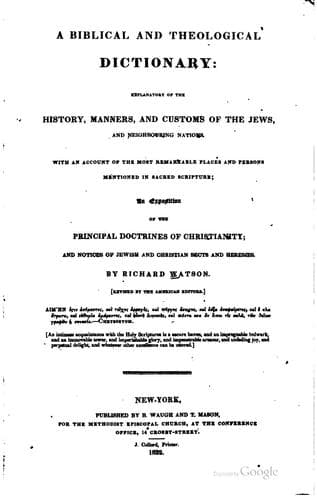
A Biblical and Theological Dictionary: explanatory of the history, manners, and customs of the Jews, and neighbouring nationsWatson, Richard
Religion
A Biblical and Theological Dictionary: explanatory of the history, manners, and customs of the Jews, and neighbouring nations
Watson, Richard
Bible -- Dictionaries; Theology -- Dictionaries
ARM. As it is by this member of the body that we chiefly exert our
strength, it is therefore used in Scripture for an emblem of power. Thus
God is said to have delivered his people from Egyptian bondage “with a
stretched-out arm,” Deut. v, 15; and he thus threatens Eli the high
priest, “I will cut off thine arm, and the arm of thy father’s house,” 1
Sam. ii, 31; that is, I will deprive thee and thy family of power and
authority.
ARMAGEDDON, a place spoken of, Rev. xvi, 16, which literally signifies
“the mountain of Mageddon,” or “Megiddo,” a city situated in the great
plain at the foot of Mount Carmel, where the good prince Josiah received
his mortal wound, in the battle against Necho, king of Egypt. At
Armageddon, the three unclean spirits coming out of the dragon’s mouth
shall gather together the kings of the earth, to the battle of the great
day of God Almighty, Rev. xvi, 13, 14; where the word Armageddon,
according to Mr. Pool, does not signify any particular place, but is
used in allusion to Megiddo, mentioned Judges v, 19, where Barak
overcame Sisera with his great army, and where Josiah was slain, 2 Kings
xxiii, 30. If so, the term must have been a proverbial one for a place
of destruction and mourning.
ARMENIA, a considerable country of Asia, having Colchis and Iberia on
the north, Media on the east, Mesopotamia on the south, Pontus and
Cappadocia on the west, and the Euphrates and Syria on the south-west.
Armenia is often confounded with Aramæa, the land of Aram or Syria; but
they are totally different. Armenia, which is separated from Aram by
Mount Taurus, was so denominated from Ar-Men, the mountainous country of
Meni or Minni, the people of which country are mentioned under this name
by Jeremiah, when summoning the nations against Babylon.
The people of this country have in all ages maintained a great
similarity of character, partly commercial and partly pastoral. They
have, in fact, in the northern parts of the Asiatic continent, been what
the Cushites and Ishmaelites were in the south, tenders of cattle,
living on the produce of their flocks and herds, and carriers of
merchandize between the neighbouring nations; a part living at home with
their flocks, and a part travelling as merchants and dealers into
distant countries. In the flourishing times of Tyre, the Armenians,
according to Ezekiel, xxvii, 14, brought horses and mules to the markets
of that city; and, according to Herodotus, they had a considerable trade
in wine, which they sent down the Euphrates to Babylon, &c. At the
present day, the Armenians are the principal traders of the east; and
are to be found in the capacity of merchants or commercial agents all
over Asia, a patient, frugal, industrious, and honest people, whose
known character for these virtues has withstood the tyranny and
extortions of the wretched governments under which they chiefly live.
Public-domain text, read in full here on John Shaqi.
Reviews
Reviews
No reviews yet
Be the first to share your thoughts on this work.
Elsewhere in the archive
Join the Discussion
Join the discussion
Sign in to leave a comment or review.
Sign InorCreate an account