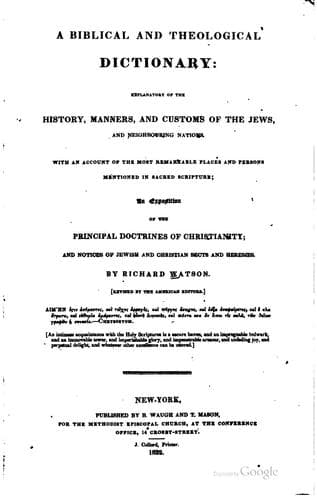
A Biblical and Theological Dictionary: explanatory of the history, manners, and customs of the Jews, and neighbouring nationsWatson, Richard
Religion
A Biblical and Theological Dictionary: explanatory of the history, manners, and customs of the Jews, and neighbouring nations
Watson, Richard
Bible -- Dictionaries; Theology -- Dictionaries
At the head of each rank or file of fifty, was the captain of fifty. The
other divisions consisted of a hundred, a thousand, and ten thousand
men, each one of which was headed by its appropriate commander. These
divisions ranked in respect to each other according to their families,
and were subject to the authority of the heads of those families, 2
Chron. xxv, 5; xxvi, 12, 13. The centurions, and _chiliarchs_ or
captains of thousands, were admitted into the councils of war, 1 Chron.
xiii, 1–3; 1 Sam. xviii, 13. The leader of the whole army was
denominated אל־שרהצכא, _the captain of the host_. The genealogists, (in
the English version, _officers_,) according to a law in Deut. xx, 9, had
the right of appointing the persons who were to act as officers in the
army; and they, undoubtedly, made it a point, in their selections, to
choose those who are called heads of families. The practice of thus
selecting military officers ceased under the kings. Some of them were
then chosen by the king, and in other instances the office became
permanent and hereditary in the heads of families. Both kings and
generals had armour bearers, נשא כלים. They were chosen from the bravest
of the soldiery, and not only bore the arms of their masters, but were
employed to give his commands to the subordinate captains, and were
present at his side in the hour of peril, 1 Sam. xiv, 6; xvii, 7. The
infantry, the cavalry, and the chariots of war were so arranged, as to
make separate divisions of an army, Exod. xiv, 6, 7. The infantry were
divided likewise into light-armed troops, גדודים, and into spearmen,
Genesis xlix, 19; 1 Samuel xxx, 8, 15, 23; 2 Sam. iii, 22; iv, 2; xxii,
30; Psalm xviii, 30; 2 Kings v, 2; Hosea vii, 1. The light-armed
infantry were furnished with a sling and javelin, with a bow, arrows,
and quiver, and also, at least in latter times, with a buckler. They
fought the enemy at a distance. The spearmen, on the contrary, who were
armed with spears, swords, and shields, fought hand to hand, 1 Chron.
xii, 24, 34; 2 Chron. xiv, 8; xvii, 17. The light-armed troops were
commonly taken from the tribes of Ephraim and Benjamin, 2 Chron. xiv, 8;
xvii, 17. Compare Gen. xlix, 27; Psalm lxxviii, 9.
Public-domain text, read in full here on John Shaqi.
Reviews
Reviews
No reviews yet
Be the first to share your thoughts on this work.
Elsewhere in the archive
Join the Discussion
Join the discussion
Sign in to leave a comment or review.
Sign InorCreate an account