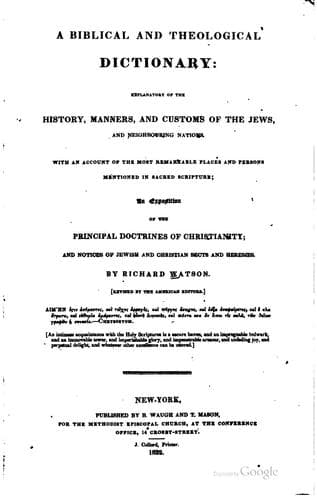
A Biblical and Theological Dictionary: explanatory of the history, manners, and customs of the Jews, and neighbouring nationsWatson, Richard
Religion
A Biblical and Theological Dictionary: explanatory of the history, manners, and customs of the Jews, and neighbouring nations
Watson, Richard
Bible -- Dictionaries; Theology -- Dictionaries
“They have among them a number of monasteries and convents, in which is
maintained a severe discipline; marriage is discountenanced, though not
absolutely prohibited; a married priest cannot obtain promotion, and the
higher clergy are not allowed to marry. They worship in the eastern
manner, by prostration: they are very superstitious, and their
ceremonies much resemble those of the Greek church. Once in their lives
they generally perform a pilgrimage to Jerusalem; and in 1819, the
number of Armenian pilgrims was thirteen hundred, nearly as many as the
Greeks. Dr. Buchanan, however, says, ‘Of all the Christians in central
Asia, they have preserved themselves most free from Mohammedan and Papal
corruptions.’”
ARMIES. In the reign of David, the Hebrews acquired such skill in the
military art, together with such strength, as gave them a decided
superiority over their competitors on the field of battle. David
increased the standing army, which Saul had introduced. Solomon
introduced cavalry into the military force of the nation, also chariots.
Both cavalry and chariots were retained in the subsequent age; an age,
in which military arms were improved in their construction, the science
of fortification made advances, and large armies were mustered. From
this period, till the time when the Hebrews became subject to the
Assyrians and Chaldeans, but little improvement was made in the arts of
war. The Maccabees, after the return of the Hebrews from the captivity,
gave a new existence to the military art among them. But their
descendants were under the necessity of submitting to the superior power
of the Romans.
Whenever there was an immediate prospect of war, a levy was made by the
genealogists, Deut. xx, 5–9. In the time of the kings, there was a head
or ruler of the persons, that made the levy, denominated השוטר, who kept
an account of the number of the soldiers, but who is, nevertheless, to
be distinguished from the generalissimo, הסופר, 2 Chron. xxvi, 11.
Compare 2 Sam. viii, 17; xx, 25; 1 Chron. xviii, 16. After the levy was
fully made out, the genealogists gave public notice, that the following
persons might be excused, from military service, Deut. xx, 5–8: 1. Those
who had built a house, and had not yet inhabited it. 2. Those who had
planted a כרס, that is, _an olive_ or _vine garden_, and had not as yet
tasted the fruit of it; an exemption, consequently, which extended
through the first five years after such planting. 3. Those who had
bargained for a spouse, but had not celebrated the nuptials; also those
who had not as yet lived with their wife, for a year. 4. The
faint-hearted, who would be likely to discourage others, and who, if
they had gone into battle, where, in those early times, every thing
depended on personal prowess, would only have fallen victims.
Public-domain text, read in full here on John Shaqi.
Reviews
Reviews
No reviews yet
Be the first to share your thoughts on this work.
Elsewhere in the archive
Join the Discussion
Join the discussion
Sign in to leave a comment or review.
Sign InorCreate an account