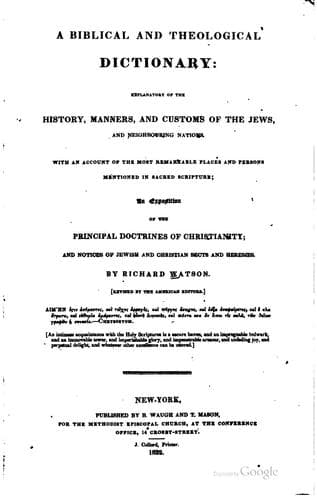
A Biblical and Theological Dictionary: explanatory of the history, manners, and customs of the Jews, and neighbouring nationsWatson, Richard
Religion
A Biblical and Theological Dictionary: explanatory of the history, manners, and customs of the Jews, and neighbouring nations
Watson, Richard
Bible -- Dictionaries; Theology -- Dictionaries
its appearance on such an elevated position, than the war-cry was
uttered, and the trumpets were blown, Isaiah v, 26; xiii, 2; xviii, 3;
xxx, 17; xlix, 22; lxii, 10–13.
Before battle the various kinds of arms were put into the best order;
the shields were anointed, and the soldiers refreshed themselves by
taking food, lest they should become weary and faint under the pressure
of their labours, Jer. xlvi, 3, 4; Isaiah xxi, 5. The soldiers, more
especially the generals and kings, except when they wished to remain
unknown, 1 Kings xxii, 30–34, were clothed in splendid habiliments,
which are denominated, בהדרי-קדש, _the sacred dress_, Psalm cx, 3. It
was the duty of the priests, before the commencement of the battle, to
exhort the Hebrews to exhibit that courage which was required by the
exigency of the occasion. The words which they used were as
follows:--“Hear, O Israel; ye approach this day unto battle against your
enemies; let not your hearts faint; fear not, and do not tremble;
neither be ye terrified, because of them. For the Lord your God is he
that goeth with you, to fight for you against your enemies, to save
you,” Deut. xx, 2, &c. The last ceremony, previous to an engagement, was
the sounding of the sacred trumpets by the priests, Num. x, 9, 10; 2
Chron. xiii, 12–14; 1 Macc. iii, 54.
ARMINIANISM, strictly speaking, is that system of religious doctrine
which was taught by Arminius, professor of divinity in the university of
Leyden. If therefore we would learn precisely what Arminianism is, we
must have recourse to those writings in which that divine himself has
stated and expounded his peculiar tenets. This, however, will by no
means give us an accurate idea of that which, since his time, has been
usually denominated Arminianism. On examination, it will be found, that
in many important particulars, those who have called themselves
Arminians, or have been accounted such by others, differ as widely from
the nominal head and founder of their sect, as he himself did from
Calvin, and other doctors of Geneva. There are, indeed, certain points,
with regard to which he has been strictly and uniformly followed by
almost all his pretended adherents; but there are others of equal or of
greater importance, dogmatically insisted on by them, to which he
unquestionably never gave his sanction, and even appears to have been
decidedly hostile. Such a distinction, obvious as it must be to every
attentive reader, has yet been generally so far overlooked, that the
memory of Arminius is frequently loaded with imputations the most
unreasonable and unjust. He is accused, by the ignorant and the
prejudiced, of introducing corruptions into the Christian church, which
he probably never thought of, and which certainly have no place in his
works. And all the odium which his followers have from time to time
incurred by their varied and increasing heterodoxy, has been absurdly
reflected upon him, as if he could be responsible for every error that
Public-domain text, read in full here on John Shaqi.
Reviews
Reviews
No reviews yet
Be the first to share your thoughts on this work.
Elsewhere in the archive
Join the Discussion
Join the discussion
Sign in to leave a comment or review.
Sign InorCreate an account