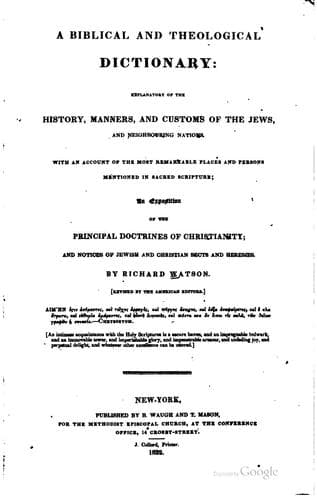
A Biblical and Theological Dictionary: explanatory of the history, manners, and customs of the Jews, and neighbouring nationsWatson, Richard
Religion
A Biblical and Theological Dictionary: explanatory of the history, manners, and customs of the Jews, and neighbouring nations
Watson, Richard
Bible -- Dictionaries; Theology -- Dictionaries
may be sent abroad under the sanction of his name. Whatever be the
number or the species of these errors, and in whatever way they may be
associated with his principles, it is fair to the character of Arminius,
and useful to the interests of religious truth, to revert to his own
writings as the only source from which we ought to derive information
concerning the Arminian scheme; and by doing so, it may be discovered,
that genuine unadulterated Arminianism is not that great and dangerous
heresy which among a certain class of Christians it is too often
represented to be.
Arminianism, in its proper sense, is to be considered as a separation
from Calvinism, with regard to the doctrines of unconditional election,
particular redemption, and other points necessarily resulting from
these. The Calvinists held that God had elected a certain portion of the
human race to eternal life, passing by the rest, or rather dooming them
to everlasting destruction; that God’s election proceeded upon no
prescience of the moral principles and character of those whom he had
thus predestinated, but originated solely in the motions of his free and
sovereign mercy; that Christ died for the elect only, and therefore that
the merits of his death can avail for the salvation of none but them;
and that they are constrained by the irresistible power of divine grace
to accept of him as their Saviour. To this doctrine, that of Arminius
and his legitimate followers stands opposed. They do not deny an
election; but they deny that it is absolute and unconditional. They
argue, that an election of this kind is inconsistent with the character
of God, that it destroys the liberty of the human will, that it
contradicts the language of Scripture, and that it tends to encourage a
careless and licentious practice in those by whom it is believed. They
maintain that God has elected those only who, according, not to his
decree, but to his foreknowledge, and in the exercise of their natural
powers of self-determination, acting under the influence of his grace,
would possess that faith and holiness to which salvation is annexed in
the Gospel scheme. And those who are _not_ elected are allowed to
perish, not because they were not elected, but merely and solely in
consequence of their infidelity and disobedience; on account, indeed, of
which infidelity and disobedience being foreseen by God, their election
did not take place. They hold, that Christ died for _all_ men in the
literal and unrestricted sense of that phrase; that his atonement is
able, both from its own merit, and from the intention of him who
appointed it, to expiate the guilt of every individual; that every
individual is invited to partake of the benefits which it has procured;
that the grace of God is offered to make the will comply with this
invitation, but that this grace may be resisted and rendered ineffectual
by the sinner’s perversity. Whether true believers necessarily
Public-domain text, read in full here on John Shaqi.
Reviews
Reviews
No reviews yet
Be the first to share your thoughts on this work.
Elsewhere in the archive
Join the Discussion
Join the discussion
Sign in to leave a comment or review.
Sign InorCreate an account