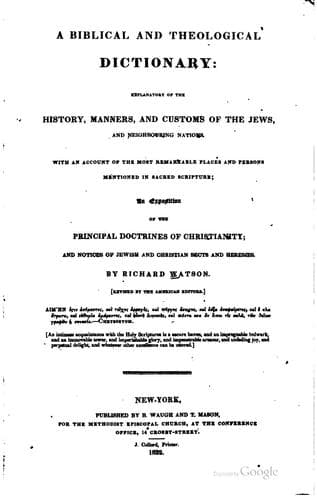
A Biblical and Theological Dictionary: explanatory of the history, manners, and customs of the Jews, and neighbouring nationsWatson, Richard
Religion
A Biblical and Theological Dictionary: explanatory of the history, manners, and customs of the Jews, and neighbouring nations
Watson, Richard
Bible -- Dictionaries; Theology -- Dictionaries
persevered, or whether they might fall from their faith, and forfeit
their state of grace, was a question which Arminius left in a great
measure unresolved, but which was soon determined by his followers in
this additional proposition, that saints may fall from the state of
grace, in which they are placed by the operation of the Holy Spirit.
This, indeed, seems to follow as a corollary, from what Arminius
maintained respecting the natural freedom and corruption of the will,
and the resistibility of divine grace.
It may now be proper to mention some tenets with regard to which
Arminianism has been much misrepresented. If a man hold that good works
are necessary to justification; if he maintain that faith includes good
works in its own nature; if he reject the doctrine of original sin; if
he deny that divine grace is requisite for the whole work of
sanctification; if he speak of human virtue as meritorious in the sight
of God; it is very generally concluded, that he is an Arminian. But the
truth is, that a man of such sentiments is properly a disciple of the
Pelagian and Socinian schools. To such sentiments pure Arminianism is as
diametrically opposite as Calvinism itself. The genuine Arminians admit
the corruption of human nature in its full extent. They admit, that we
are justified by faith only. They admit, that our justification
originates solely in the grace of God. They admit, that the procuring
and meritorious cause of our justification is the righteousness of
Christ. _Propter quam_, says Arminius, _Deus credentibus peccatum
condonat, eosque pro justis reputat non aliter atque si legem perfectè
implevissent_. [For the sake of which God pardons believers, and
accounts them as righteous precisely as if they had perfectly obeyed the
law.] They admit in this way, that justification implies not merely
forgiveness of sin, but acceptance to everlasting happiness. _Junctam
habet adoptionem in filios, et collationem juris in hereditatem vitæ
eternæ._ [It has connected with it adoption to sonship, and the grant of
a right to the inheritance of eternal life.] They admit, in fine, that
the work of sanctification, from its very commencement to its perfection
in glory, is carried on by the operation of the Holy Spirit, which is
the gift of God by Jesus Christ. So sound, indeed, are the Arminians
with respect to the doctrine of justification, a doctrine so important
and essential in the opinion of Luther, that he scrupled not to call it,
_articulus ecclesiæ stantis vel cadentis_; [the article with which the
church stands or falls;] that those who look into the writings of
Arminius may be disposed to suspect him of having even exceeded Calvin
in orthodoxy. It is certain, at least, that he declares his willingness
to subscribe to every thing that Calvin has written on that leading
subject of Christianity, in the third book of his Institutes; and with
this declaration the tenor of his writings invariably corresponds.
Public-domain text, read in full here on John Shaqi.
Reviews
Reviews
No reviews yet
Be the first to share your thoughts on this work.
Elsewhere in the archive
Join the Discussion
Join the discussion
Sign in to leave a comment or review.
Sign InorCreate an account