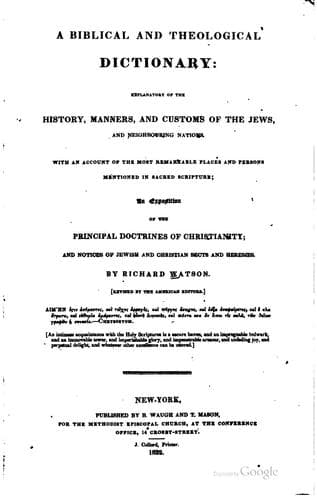
A Biblical and Theological Dictionary: explanatory of the history, manners, and customs of the Jews, and neighbouring nationsWatson, Richard
Religion
A Biblical and Theological Dictionary: explanatory of the history, manners, and customs of the Jews, and neighbouring nations
Watson, Richard
Bible -- Dictionaries; Theology -- Dictionaries
The hopes of success which the Arminians entertained from the indulgent
manner in which they were treated by the civil authorities, were soon
blasted by a misunderstanding which had secretly subsisted for some time
between the stadtholder and the principal magistrates, and at last broke
forth into an open rupture. Maurice, being suspected of aiming at
sovereign power, was firmly opposed by the leading persons in the
government, who had been the friends and patrons of the Arminians, and
to whom, therefore, these adhered at this difficult crisis. On the other
hand, the Gomarists, or Calvinists, attached themselves to Maurice, and
inflamed the resentment which he had already, for various reasons,
conceived against the Arminians. The prince was resolved, at once to
ruin the ministers who had ventured to oppose his schemes of usurpation,
and to crush the Arminians, by whom those statesmen had been warmly
supported. For this purpose he got the leading men cast into prison.
Barnevelt, whose long and faithful services deserved a better fate, died
on the scaffold: and Grotius and Hoogerbeets, under pretexts more
plausible than solid, were unjustly condemned to perpetual imprisonment,
from which, however, the former afterward escaped, and fled into France.
The alleged crime of the Arminians being of an ecclesiastical nature, it
was thought proper to bring their cause before a national assembly of
divines by which their religious opinions might be regularly and finally
condemned.
Under the auspices of Maurice, therefore, and by the authority of the
states general, a synod was convoked at Dort, in the year 1618. Before
this meeting, which consisted of deputies from the United Provinces,
from England, Scotland, Switzerland, and other places, the Arminians
appeared, with Episcopius at their head, to answer to the accusations
brought against them, of departing from the established religion. For a
full account of the proceedings of this synod, the reader may consult
the second and third volumes of Brandt’s History of the Reformation, and
the Remains of Mr. John Hales of Eaton, who was present at the meeting,
and gives a simple narrative of what he saw and heard. The conduct of
the synod has been applauded by some, and condemned by others. On the
one hand, it has been placed above every other synod since the Apostolic
age, for its temper, moderation, and sanctity; on the other, it has been
charged with injustice and cruelty, and burlesqued in such lines as
these:--
_Dordrechti synodus nodus; chorus integer, æger; Conventus, ventus;
sessio, stramen, Amen._
[The point of this doggrel, which consists chiefly in the gingle of the
Latin words, is lost in a translation. The following is a literal
version:--
The synod of Dort, a knot; the whole assembly, sick;
The convention, wind; the session, straw, Amen.]
Public-domain text, read in full here on John Shaqi.
Reviews
Reviews
No reviews yet
Be the first to share your thoughts on this work.
Elsewhere in the archive
Join the Discussion
Join the discussion
Sign in to leave a comment or review.
Sign InorCreate an account