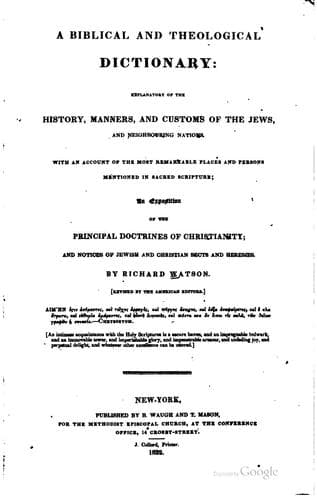
A Biblical and Theological Dictionary: explanatory of the history, manners, and customs of the Jews, and neighbouring nationsWatson, Richard
Religion
A Biblical and Theological Dictionary: explanatory of the history, manners, and customs of the Jews, and neighbouring nations
Watson, Richard
Bible -- Dictionaries; Theology -- Dictionaries
Neal remarks, that it behaved as well as most assemblies of a similar
kind have done, “who have pretended to establish articles for other
men’s faith, with penal sanctions.” This says very little for the synod
of Dort; though, perhaps, it is even more than can be said with truth.
Martinius of Bremen seems to have spoken much more correctly, when he
told his friends, “I believe now what Gregory Nazianzen says, that he
had never seen any council attended with good effects, but that it
always increased the evil rather than removed it. I declare as well as
that father, that I will never set my foot in any synod again. O Dort!
Dort! would to God that I had never seen thee!” The Arminians, it is
contended, asked more indulgence than they had reason to expect; however
it is certain that the treatment which they received from the synod, was
arbitrary, faithless, and oppressive. They were at length found guilty
of heresy, and of hostility to their country and its religion. And the
measures adopted against them, in consequence of this sentence, were of
the most severe and rigorous kind. They were excommunicated; they were
driven from all their offices, civil and ecclesiastical; their ministers
were prohibited from preaching; and their congregations were suppressed.
Refusing to submit to the two last of these hard decrees, they were
subjected to fines, imprisonments, and various other punishments. To
avoid this tyrannical treatment, many of them retired to Antwerp, others
to France, and a considerable number into Holstein, where they were
kindly received by Frederick the duke, and where, in the form of a
colony, they built for themselves a handsome town, naming it
Frederickstadt, in compliment to their friend and protector. The history
of this colony may be found in a work entitled _Epistolæ Præstantium et
Eruditorum Virorum Ecclesiasticæ et Theologicæ_, and published by
Limborch and Hartsoeker.
Public-domain text, read in full here on John Shaqi.
Reviews
Reviews
No reviews yet
Be the first to share your thoughts on this work.
Elsewhere in the archive
Join the Discussion
Join the discussion
Sign in to leave a comment or review.
Sign InorCreate an account