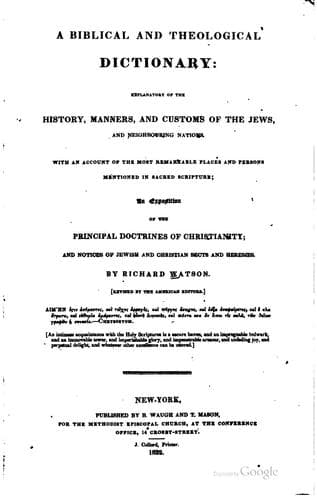
A Biblical and Theological Dictionary: explanatory of the history, manners, and customs of the Jews, and neighbouring nationsWatson, Richard
Religion
A Biblical and Theological Dictionary: explanatory of the history, manners, and customs of the Jews, and neighbouring nations
Watson, Richard
Bible -- Dictionaries; Theology -- Dictionaries
ARMS. The Hebrews do not appear to have had any peculiar military habit.
As the flowing dress which they ordinarily wore would have impeded their
movements, they girt it closely around them when preparing for battle,
and loosened it on their return, 2 Sam. xx, 8; 1 Kings xx, 11. They used
the same arms as the neighbouring nations, both defensive and offensive;
and these were made either of iron or of brass, principally of the
latter metal. Of the defensive arms of the Hebrews, the following were
the most remarkable; namely,
1. The helmet, כובע, for covering and defending the head. This was a
part of the military provision made by Uzziah for his vast army, 2
Chron. xxvi, 14; and long before the time of that king, the helmets of
Saul and of the Philistine champion were of the same metal, 1 Sam. xvii,
38. This military cap was also worn by the Persians, Ethiopians, and
Libyans, Ezek. xxxviii, 5, and by the troops which Antiochus sent
against Judas Maccabeus, 1 Mac. vi, 35.
2. The breastplate or corslet, שדיון, was another piece of defensive
armour. Goliath, and the soldiers of Antiochus, 1 Sam. xvii, 5; 1 Mac.
vi, 35, were accoutred with this defence; which, in our authorized
translation, is variously rendered _habergeon_, _coat of mail_, and
_brigandine_, 1 Sam. xvii, 38; 2 Chron. xxvi, 14; Isa. lix, 17; Jer.
xlvi, 4. Between the joints of this _harness_, as it is termed in 1
Kings xxii, 4, the profligate Ahab was mortally wounded by an arrow,
shot at a venture. From these various renderings of the original word,
it should seem that this piece of armour covered both the back and
breast, but principally the latter. The corslets were made of various
materials: sometimes they were made of flax or cotton, woven very thick,
or of a kind of woollen felt: others again were made of iron or brazen
scales, or laminæ, laid one over another, like the scales of a fish;
others were properly what we call coats of mail; and others were
composed of two pieces of iron or brass, which protected the back and
breast. All these kinds of corslets are mentioned in the Scriptures.
Goliath’s coat of mail, 1 Sam. xvii, 5, was literally a corslet of
scales, that is, composed of numerous laminæ of brass, crossing each
other. It was called by Virgil, and other Latin writers, _squama
lorica_. Similar corslets were worn by the Persians and other nations.
The breastplate worn by the unhappy Saul, when he perished in battle, is
supposed to have been of flax, or cotton, woven very close and thick, 2
Sam. i, 9, marginal rendering.
Public-domain text, read in full here on John Shaqi.
Reviews
Reviews
No reviews yet
Be the first to share your thoughts on this work.
Elsewhere in the archive
Join the Discussion
Join the discussion
Sign in to leave a comment or review.
Sign InorCreate an account