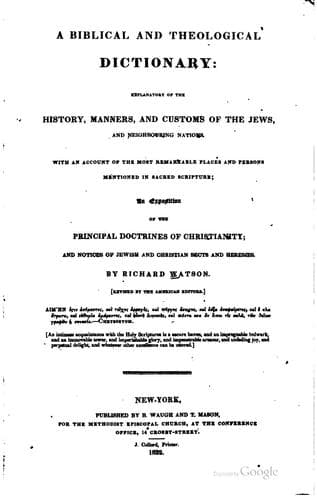
A Biblical and Theological Dictionary: explanatory of the history, manners, and customs of the Jews, and neighbouring nationsWatson, Richard
Religion
A Biblical and Theological Dictionary: explanatory of the history, manners, and customs of the Jews, and neighbouring nations
Watson, Richard
Bible -- Dictionaries; Theology -- Dictionaries
The tenets of the Arminians may be comprised in the following five
articles relating to predestination, universal redemption, the
corruption of men, conversion, and perseverance, viz. 1. That God, from
all eternity, determined to bestow salvation on those whom he foresaw
would persevere unto the end in their faith in Christ Jesus; and to
inflict everlasting punishment on those who should continue in their
unbelief, and resist unto the end his divine succours; so that election
was conditional, and reprobation in like manner the result of foreseen
infidelity and persevering wickedness. 2. That Jesus Christ, by his
sufferings and death, made an atonement for the sins of all mankind in
general, and of every individual in particular; that, however, none but
those who believe in him can be partakers of the divine benefits. 3.
That true faith cannot proceed from the exercise of our natural
faculties and powers, nor from the force and operation of free will;
since man, in consequence of his natural corruption, is incapable either
of thinking or doing any good thing; and that, therefore, it is
necessary, in order to his salvation, that he be regenerated and renewed
by the operation of the Holy Ghost, which is the gift of God through
Jesus Christ. 4. That this divine grace or energy of the Holy Ghost
begins and perfects every thing that can be called good in man, and
consequently all good works are to be attributed to God alone; that,
nevertheless, this grace is offered to all, and does not force men to
act against their inclinations, but may be resisted and rendered
ineffectual by the perverse wills of impenitent sinners. 5. That God
gives to the truly faithful, who are regenerated by his grace, the means
of preserving themselves in this state; and though the first Arminians
made some doubt with respect to the closing part of this article, their
followers uniformly maintain, that the regenerate may lose true
justifying faith, forfeit their state of grace, and die in their sins.
The Arminians are also called _Remonstrants_, from an humble petition
entitled their _Remonstrance_, which, in the year 1610, they addressed
to the States of Holland. Their principal writers are, _Arminius_,
_Episcopius_, _Uitenbogart_, _Grotius_, _Curcellæus_, _Limborch_, _Le
Clerc_, _Wetstein_, _Goodwin_, _Whitby_, _Wesley_, _Fletcher_,
_Tomline_, _&c._ The works of Arminius, with a copious account of his
life and times, have been recently translated into English, by Mr. James
Nichols; and have not only served to dissipate many misconceptions
respecting the sentiments of this celebrated divine, which had prevailed
in England, where the Pelagianism of some eminent divines, generally
called ARMINIAN, had been unjustly charged upon him; but have added a
most valuable collection of treatises to our theological literature.
Public-domain text, read in full here on John Shaqi.
Reviews
Reviews
No reviews yet
Be the first to share your thoughts on this work.
Elsewhere in the archive
Join the Discussion
Join the discussion
Sign in to leave a comment or review.
Sign InorCreate an account