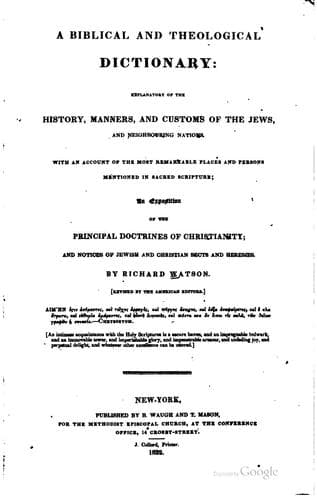
A Biblical and Theological Dictionary: explanatory of the history, manners, and customs of the Jews, and neighbouring nationsWatson, Richard
Religion
A Biblical and Theological Dictionary: explanatory of the history, manners, and customs of the Jews, and neighbouring nations
Watson, Richard
Bible -- Dictionaries; Theology -- Dictionaries
3. The spear and javelin (as the words רמח and חנית are variously
rendered in Num. xxv, 7; 1 Sam. xiii, 19, and Jer. xlvi, 4) were of
different kinds, according to their length or make. Some of them might
be thrown or darted, 1 Sam. xviii, 11; others were a kind of long
swords, Num. xxv, 8; and it appears from 2 Sam. ii, 23, that some of
them were pointed at both ends. When armies were encamped, the spear of
the general or commander-in-chief was stuck into the ground at his head.
4. Slings are enumerated among the military stores collected by Uzziah,
2 Chron. xxvi, 14. In the use of the sling David eminently excelled, and
he slew Goliath with a stone from one. The Benjaminites were celebrated
in battle because they had attained to great skill and accuracy in
handling this weapon; “they could sling stones to a hair’s breadth, and
not miss,” Judges xx, 16; and where it is said that they were
left-handed, it should rather be rendered _ambidexters_; for we are told
they could use “both the right hand and the left,” 1 Chron. xii, 2; that
is, they did not constantly use the right hand as others did, when they
shot arrows or slung stones; but they were so expert in their military
exercises, that they could perform them with their left hand as well as
with their right.
5. Bows and arrows are of great antiquity; indeed, no weapon is
mentioned so early. Thus Isaac said to Esau, “Take thy weapons, thy
quiver and thy bow,” Gen. xxvii, 3; though, it is true, these are not
spoken of as used in war, but in hunting; and so they are supposed and
implied before this, where it is said of Ishmael, that he became an
archer, he used bows and arrows in shooting of wild beasts, Gen. xxi,
20. This afterward became so useful a weapon, that care was taken to
train up the Hebrew youth to it betimes. When David had, in a solemn
manner, lamented the death of King Saul, he gave orders for teaching the
young men the use of the bow, 1 Sam. i, 18, that they might be as expert
as the Philistines, by whose bows and arrows Saul and his army were
slain. These were part of the military ammunition; for in those times
bows were used instead of guns, and arrows supplied the place of powder
and ball. From the book of Job, xx, 24, it may be collected, that the
military bow was made of steel, and consequently was very stiff and hard
to bend, on which account they used their foot in bending their bows;
and therefore when the prophets speak of _treading the bow_ and of _bows
trodden_, they are to be understood of _bows bent_, as our translators
rightly render it, Jer. 1, 14; Isa. v, 28; xxi, 15; but the Hebrew word
which is used in these places, signifies _to tread upon_. This weapon
was thought so necessary in war, that it is there called, “the bow of
war,” or the “battle-bow,” Zech. ix, 10; x, 14.
ARNON, a river or brook, mentioned Num. xxi, 24, and elsewhere. Its
spring head is in the mountains of Gilead, or of the Moabites, and it
discharges itself into the Dead Sea.
Public-domain text, read in full here on John Shaqi.
Reviews
Reviews
No reviews yet
Be the first to share your thoughts on this work.
Elsewhere in the archive
Join the Discussion
Join the discussion
Sign in to leave a comment or review.
Sign InorCreate an account