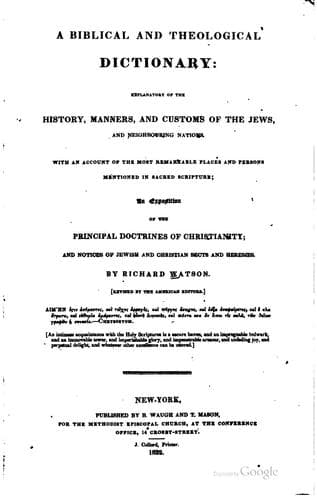
A Biblical and Theological Dictionary: explanatory of the history, manners, and customs of the Jews, and neighbouring nationsWatson, Richard
Religion
A Biblical and Theological Dictionary: explanatory of the history, manners, and customs of the Jews, and neighbouring nations
Watson, Richard
Bible -- Dictionaries; Theology -- Dictionaries
ARROW. See ARMS. Divination with arrows was a method of presaging future
events, practised by the ancients. Ezekiel, xxi, 21, informs us, that
Nebuchadnezzar, putting himself at the head of his armies, to march
against Zedekiah, king of the Jews, and against the king of the
Ammonites, stood at the parting of two ways, to mingle his arrows
together in a quiver, in order to divine from thence which way he should
march. Jerom, Theodoret, and the modern commentators after them, believe
that this prince took several arrows, and upon each of them wrote the
name of the king, town, or province, which he was to attack: for
example, upon one, Jerusalem; upon another, Rabbah, the capital of the
Ammonites; and upon another, Egypt, &c. After having put these into a
quiver, he shook them together, and then drew them out; and the arrow
which was drawn was thought to declare the will of the gods to attack
first that city, province, or kingdom, with whose name it was inscribed.
ARTAXERXES, or AHASUERUS, a king of Persia, the husband of Esther, who,
in the opinion of the learned Usher and Calmet, was the Darius of
profane authors. See AHASUERUS.
2. ARTAXERXES LONGIMANUS is supposed by Dr. Prideaux to be the Ahasuerus
of Esther. He was the son of Xerxes, and grandson of Darius Hystaspes,
and reigned in Persia from the year of the world 3531 to 3579. He
permitted Ezra, with all those inclined to follow him, to return into
Judea, in the year of the world 3537, Ezra vii, viii. Afterward,
Nehemiah also obtained leave to return, and to build the walls and gates
of Jerusalem, in the year of the world 3550, Nehem. i, 11. From this
year, chronologers reckon the beginning of Daniel’s seventy weeks,
Daniel xi, 29. These are weeks of years, and make four hundred and
ninety years. Dr. Prideaux, who discourses very copiously, and with
great learning, on this prophecy, maintains that the decree mentioned in
it for the restoring and rebuilding of Jerusalem, cannot be understood
of that granted to Nehemiah, in the twentieth year of Artaxerxes; but of
that granted to Ezra, by the same Artaxerxes, in the seventh year of his
reign. From that time to the death of Christ, are exactly four hundred
and ninety years, to a month: for in the month Nisan the decree was
granted to Ezra; and in the middle of the same month Nisan, Christ
suffered, just four hundred and ninety years afterward.
Public-domain text, read in full here on John Shaqi.
Reviews
Reviews
No reviews yet
Be the first to share your thoughts on this work.
Elsewhere in the archive
Join the Discussion
Join the discussion
Sign in to leave a comment or review.
Sign InorCreate an account