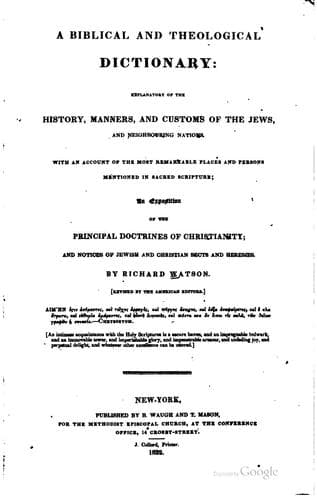
A Biblical and Theological Dictionary: explanatory of the history, manners, and customs of the Jews, and neighbouring nationsWatson, Richard
Religion
A Biblical and Theological Dictionary: explanatory of the history, manners, and customs of the Jews, and neighbouring nations
Watson, Richard
Bible -- Dictionaries; Theology -- Dictionaries
The easterns think that the surname of Longimanus was given to
Artaxerxes by reason of the extent of his dominions; as it is commonly
said that princes have long hands: but the Greeks maintain that this
prince had really longer hands or arms than usual; and that, when he
stood upright, he could touch his knees. He is said to have been the
handsomest man of his time. The eastern people call him Bahaman, and
give him the surname of Ardschir-diraz-dest, or the long-handed. He was
the son of Asfendiar, sixth king of the second dynasty of the Persians.
After having extinguished the family of Rostam, which was formidable to
him on account of the great men who composed it, he carried his arms
into the western provinces, Mesopotamia and Syria, which formed part of
his empire. He took Babylon from Belshazzar, son of Nebuchadnezzar; and
he put in his place Kiresch, who by us is called Cyrus. Some Persian
historians assert that the mother of Artaxerxes was a Jewess, of the
tribe of Benjamin, and family of Saul; and that the most beloved of his
wives was of the tribe of Judah, and race of Solomon, by Rehoboam, king
of Judah. If this be true, we need not wonder that he should recommend
to Cyrus to favour the Jewish nation. This Cyrus performed, by sending
back the people into their own country, and permitting them to rebuild
their temple. But the truth of this story is doubtful; and were it true,
the interference of the special providence of God must still be
acknowledged. Artaxerxes reigned forty-seven years, and died in the year
of the world 3579, and before Jesus Christ 425.
ARTEMAS, St. Paul’s disciple, who was sent by that Apostle into Crete,
in the room of Titus, chap. iii, 12, while he continued with St. Paul at
Nicopolis, where he passed the winter. We know nothing particular of the
life or death of Artemas; but the employment to which he was appointed
by the Apostle is a proof of his great merit.
ASA, the son and successor of Abijam, king of Judah, began to reign in
the year of the world 3049, and before Christ 955. He reigned forty-one
years at Jerusalem, and did right in the sight of the Lord. He purged
Jerusalem from the infamous practices attending the worship of idols;
and he deprived his mother of her office and dignity of queen, because
she erected an idol to Astarte, which he burnt in the valley of Hinnom,
1 Kings xv, 8, &c.
Public-domain text, read in full here on John Shaqi.
Reviews
Reviews
No reviews yet
Be the first to share your thoughts on this work.
Elsewhere in the archive
Join the Discussion
Join the discussion
Sign in to leave a comment or review.
Sign InorCreate an account