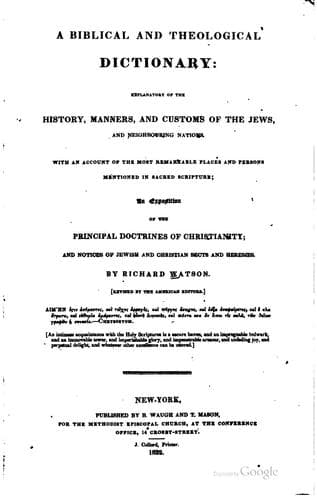
A Biblical and Theological Dictionary: explanatory of the history, manners, and customs of the Jews, and neighbouring nationsWatson, Richard
Religion
A Biblical and Theological Dictionary: explanatory of the history, manners, and customs of the Jews, and neighbouring nations
Watson, Richard
Bible -- Dictionaries; Theology -- Dictionaries
In this year Baasha, king of Israel, began to fortify Ramah, on the
frontiers of the two kingdoms of Judah and Israel, that he might prevent
the Israelites from resorting to the kingdom of Judah, and the temple of
the Lord at Jerusalem. When Asa was informed of this, he sent to
Benhadad, king of Damascus, all the gold and silver of his palace, and
of the temple, to induce him to break his alliance with Baasha, and to
assist him against the king of Israel. Benhadad accepted Asa’s presents,
and invaded Baasha’s country, where he took several cities belonging to
the tribe of Naphtali. This obliged Baasha to retire from Ramah, that he
might defend his dominions nearer home. Asa immediately ordered his
people to Ramah, carried off all the materials prepared by Baasha, and
employed them in building Geba and Mizpah. This application to Benhadad
for assistance was inexcusable. It implied, that Asa distrusted God’s
power and goodness, which he had so lately experienced. Therefore the
Prophet Hanani was sent to reprove him for his conduct. Asa, however,
was so exasperated at his rebukes that he put the Prophet in chains, and
at the same time ordered the execution of several persons in Judah.
Toward the latter part of his life, he was incommoded with swellings in
his feet, which, gradually rising upwards, killed him. The Scripture
reproaches him with having had recourse to physicians, rather than to
the Lord. He was buried in the sepulchre which he had provided for
himself in the city of David; and after his death they placed on the bed
great quantities of perfumes and spices, with which his body was burned.
His bones and ashes were then collected, and put into his grave.
ASAHEL, the son of Zeruiah, and brother of Joab. He was killed by Abner,
in the battle of Gibeon, 2 Sam. ii, 18, 19, while he obstinately
persisted in the pursuit of that general. To revenge his death, his
brother Joab, some years after, treacherously killed Abner, who had come
to wait on David at Hebron, in order to procure him to be acknowledged
king by all Israel, 2 Sam. iii, 26, 27. See ABNER.
Public-domain text, read in full here on John Shaqi.
Reviews
Reviews
No reviews yet
Be the first to share your thoughts on this work.
Elsewhere in the archive
Join the Discussion
Join the discussion
Sign in to leave a comment or review.
Sign InorCreate an account