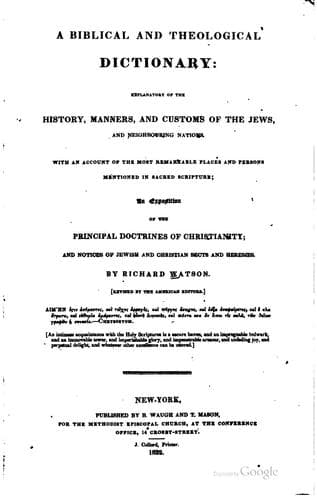
A Biblical and Theological Dictionary: explanatory of the history, manners, and customs of the Jews, and neighbouring nationsWatson, Richard
Religion
A Biblical and Theological Dictionary: explanatory of the history, manners, and customs of the Jews, and neighbouring nations
Watson, Richard
Bible -- Dictionaries; Theology -- Dictionaries
ASAPH, a celebrated musician in the time of David, was the son of
Barachias of the tribe of Levi. Asaph, and also his descendants,
presided over the musical band in the service of the temple. Several of
the psalms, as the fiftieth, the seventy-third to the eighty-third, have
the name of Asaph prefixed; but it is not certain whether the words or
the music were composed by him. With regard to some of them, which were
written during the Babylonish captivity, they cannot in any respect be
ascribed to him. Perhaps they were written or set to music by his
descendants, who bore his name, or by some of that class of musicians of
which the family of Asaph was the head, 1 Chron. vi, 39; 2 Chron. xxix,
30; xxxv, 15; Neh. xii, 46. The psalms which bear the name of Asaph are
doctrinal or preceptive: their style, though less sweet than that of
David, is more vehement, and little inferior to the grandeur of Isaiah.
ASCENSION OF CHRIST, his visible elevation to heaven. Our Saviour,
having repeatedly conversed with his Apostles after his resurrection,
and afforded them many infallible proofs of its reality, led them from
Jerusalem to Bethany, and was raised up to heaven in their sight; there
to continue till he shall descend at the last day to judge the quick and
the dead. The evidences of this fact were numerous. The disciples saw
him ascend, Acts i, 9, 10. Two angels testified that he did ascend, Acts
i, 11. Stephen, Paul, and John saw him in his ascended state, Acts vii,
55, 56; ix; Rev. i. The ascension was demonstrated by the descent of the
Holy Ghost, John xvi, 7, 14; Acts ii, 33; and the terrible overthrow and
dispersion of the Jewish nation is still a standing proof of it, John
viii, 21; Matt. xxvi, 64. The time of Christ’s ascension was forty days
after his resurrection. He continued so many days upon earth that he
might give repeated proofs of his resurrection, Acts i, 3; instruct his
Apostles in every thing of importance respecting their office and
ministry, Acts i, 3; and might open to them the Scriptures concerning
himself, and renew their commission to preach the Gospel, Acts i, 5, 6;
Mark xvi, 15. As to the manner of his ascension, it was from mount
Olivet to heaven, not in appearance only, but in reality, and that
visibly and locally. It was a real motion of his human nature; sudden,
swift, glorious, and in a triumphant manner. He was parted from his
disciples while he was solemnly blessing them; and multitudes of angels
attended him with shouts of praise, Psalm lxviii, 17; xlvii, 5, 6.
Public-domain text, read in full here on John Shaqi.
Reviews
Reviews
No reviews yet
Be the first to share your thoughts on this work.
Elsewhere in the archive
Join the Discussion
Join the discussion
Sign in to leave a comment or review.
Sign InorCreate an account