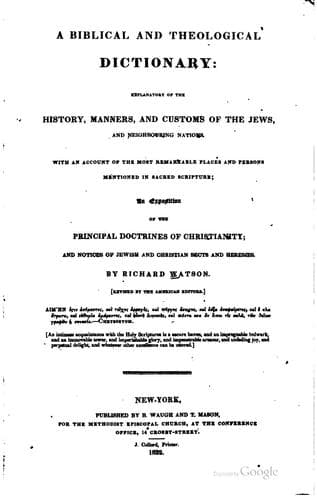
A Biblical and Theological Dictionary: explanatory of the history, manners, and customs of the Jews, and neighbouring nationsWatson, Richard
Religion
A Biblical and Theological Dictionary: explanatory of the history, manners, and customs of the Jews, and neighbouring nations
Watson, Richard
Bible -- Dictionaries; Theology -- Dictionaries
ASHES. Several religious ceremonies, and some symbolical ones, anciently
depended upon the use of ashes. To repent in sackcloth and ashes, or, as
an external sign of self-affliction for sin, or of suffering under some
misfortune, to sit in ashes, are expressions common in Scripture. “I am
but dust and ashes,” exclaims Abraham before the Lord, Gen. xviii, 27;
indicating a deep sense of his own meanness in comparison with God. God
threatens to shower down dust and ashes on the lands instead of rain,
Deut. xxviii, 24; thereby to make them barren instead of blessing them,
to dry them up instead of watering them. Tamar, after the injury she had
received from Amnon, covered her head with ashes, 2 Sam. xiii, 19. The
Psalmist, in great sorrow, says poetically, he had “eaten ashes as it
were bread,” Psalm cii, 9; that is, he sat on ashes, he threw ashes on
his head; and his food, his bread, was sprinkled with the ashes
wherewith he was himself covered. So Jeremiah introduces Jerusalem
saying, “The Lord hath covered me with ashes,” Lamentations iii, 16.
Sitting on ashes, or lying down among ashes, was a token of extreme
grief. We find it adopted by Job, ii, 8; by many Jews when in great
fear, Esther iv, 3; and by the king of Nineveh, Jonah iii, 6. He arose
from his throne, laid aside his robe, covered himself with sackcloth,
and sat in ashes. This token of affliction is illustrated by Homer’s
description of old Laertes grieving for the absence of his son,
“Sleeping in the apartment where the slaves slept, in the ashes, near
the fire.” Compare Jer. vi, 26, “Daughter of my people, wallow thyself
in ashes.” There was a sort of ley and lustral water, made with the
ashes of the heifer sacrificed on the great day of expiation; these
ashes were distributed to the people, and used in purifications, by
sprinkling, to such as had touched a dead body, or had been present at
funerals, Num. xix, 17.
ASHKENAZ, one of the sons of Gomer, and grandson of Japheth, who gave
his name to the country first peopled by him in the north and
north-western part of Asia Minor, answering to Bithynia; where were
traces long after of his name, particularly in that of Ascanius, applied
to a bay and city, as well as to some islands lying along the coast. It
was also from this country, most probably, that the king Ascanius,
mentioned by Homer, came to the aid of Priamus at the siege of Troy.
From the same source, likewise, the Pontus Euxinus, or Black Sea,
derived its name. It may farther be remarked on the identity of these
countries, that the Prophet Jeremiah, predicting the capture of Babylon,
and calling by name the countries which were to rise against it,
exclaims, “Call together against her the kingdoms of Ararat, (or
Armenia,) Minni, and Ashkenaz:” which was literally fulfilled; as
Xenophen informs us that Cyrus, after taking Sardis, became master of
Phrygia on the Hellespont, and took along with him many soldiers of that
country.
Public-domain text, read in full here on John Shaqi.
Reviews
Reviews
No reviews yet
Be the first to share your thoughts on this work.
Elsewhere in the archive
Join the Discussion
Join the discussion
Sign in to leave a comment or review.
Sign InorCreate an account