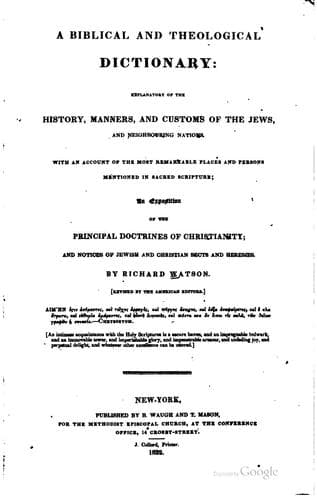
A Biblical and Theological Dictionary: explanatory of the history, manners, and customs of the Jews, and neighbouring nationsWatson, Richard
Religion
A Biblical and Theological Dictionary: explanatory of the history, manners, and customs of the Jews, and neighbouring nations
Watson, Richard
Bible -- Dictionaries; Theology -- Dictionaries
ASHTAROTH, or ASTARTE, a goddess of the Zidonians. The word Ashtaroth
properly signifies flocks of sheep, or goats; and sometimes the grove,
or woods, because she was goddess of woods, and groves were her temples.
In groves consecrated to her, such lasciviousness was committed as
rendered her worship infamous. She was also called the queen of heaven;
and sometimes her worship is said to be that of “the host of heaven.”
She was certainly represented in the same manner as Isis, with cows’
horns on her head, to denote the increase and decrease of the moon.
Cicero calls her the fourth Venus of the Syrians. She is almost always
joined with Baal, and is called a god, the Scriptures having no
particular word to express a goddess. It is believed that the moon was
adored in this idol. Her temples generally accompanied those of the sun;
and while bloody sacrifices or human victims were offered to Baal,
bread, liquors, and perfumes were presented to Astarte. For her, tables
were prepared upon the flat terrace roofs of houses, near gates, in
porches, and at crossways, on the first day of every month; and this was
called by the Greeks, Hecate’s supper.
Solomon, seduced by his foreign wives, introduced the worship of
Ashtaroth into Israel; but Jezebel, daughter of the king of Tyre, and
wife to Ahab, principally established her worship. She caused altars to
be erected to this idol in every part of Israel; and at one time four
hundred priests attended the worship of Ashtaroth, 1 Kings xviii, 7.
ASHUR, the son of Shem, who gave his name to Assyria. It is believed
that Ashur originally dwelt in the land of Shinar and about Babylonia,
but that he was compelled by the usurper Nimrod to depart from thence,
and settle higher toward the springs of the Tigris, in the province of
Assyria, so called from him, where some think he built the famous city
of Nineveh, and those of Rehoboth, Calah, and Resen, Gen. x, 11, 12.
ASIA, one of the four grand divisions of the earth. It is also used in a
more restricted sense for Asia Minor, or Anatolia. In the New Testament
it always signifies the Roman Proconsular Asia, in which the seven
Apocalyptic churches were situated.
ASKELON, a city in the land of the Philistines, situated between Azoth
and Gaza, upon the coast of the Mediterranean Sea, about 520 furlongs
from Jerusalem. The tribe of Judah, after the death of Joshua, took the
city of Askelon, Judges i, 18, being one of the five governments
belonging to the Philistines. The place at present is in ruins.
Public-domain text, read in full here on John Shaqi.
Reviews
Reviews
No reviews yet
Be the first to share your thoughts on this work.
Elsewhere in the archive
Join the Discussion
Join the discussion
Sign in to leave a comment or review.
Sign InorCreate an account