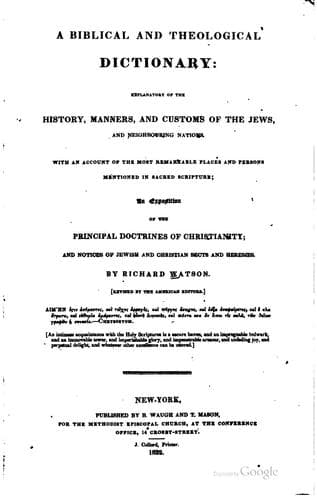
A Biblical and Theological Dictionary: explanatory of the history, manners, and customs of the Jews, and neighbouring nationsWatson, Richard
Religion
A Biblical and Theological Dictionary: explanatory of the history, manners, and customs of the Jews, and neighbouring nations
Watson, Richard
Bible -- Dictionaries; Theology -- Dictionaries
ASMONÆANS, a name given to the Maccabees, the descendants of Mattathias.
After the death of Ezra and Nehemiah, the Jews were governed by their
high priest, in subjection, however, to the Persian kings, to whom they
paid tribute; but with full enjoyment of their liberties, civil and
religious. Nearly three centuries of prosperity ensued, until they were
cruelly oppressed by Antiochus Epiphanes, king of Syria, when they were
compelled to take up arms in their own defence. Under the able conduct
of Judas, surnamed Maccabeus, and his valiant brothers, the Jews
maintained a religious war for twenty-six years with five successive
kings of Syria; and after destroying upwards of two hundred thousand of
their best troops, the Maccabees finally established the independence of
their own country, and the aggrandisement of their family. This
illustrious house, whose princes united the regal and pontifical dignity
in their own persons, administered the affairs of the Jews during a
period of a hundred and twenty-six years; until, disputes arising
between Hyrcanus II, and his brother Aristobulus, the latter was
defeated by the Romans, who captured Jerusalem, and reduced Judea to a
military province, B. C. 59.
ASNAPPER, the king of Assyria, who sent the Cutheans into the country
belonging to the ten tribes, Ezra iv, 10. Many take this prince to be
Shalmaneser; but others, with more probability, think him to be
Esar-haddon.
ASP, פתן. Deut. xxxii, 33; Job xx, 14, 16; Psalm lviii, 4; xci, 13;
Isaiah xi, 8. A very venomous serpent, whose poison is so subtle as to
kill within a few hours with a universal gangrene. This may well refer
to the _bæten_ of the Arabians, which M. Forskal describes as spotted
with black and white, about one foot in length, and nearly half an inch
in thickness, oviparous, and whose bite is death. It is the _aspic_ of
the ancients, and is so called now by the literati of Cyprus, though the
common people call it _kufi_, (κȣ́φη,) _deaf_. With the PETHEN we may
connect the _python_ of the Greeks, which was, according to fable, a
huge serpent that had an oracle at mount Parnassus, famous for
predicting future events. Apollo is said to have slain this serpent, and
hence he was called “Pythius.” Those possessed with a spirit of
divination were also styled Πυθωνες. The word occurs in Acts, xvi, 16,
as the characteristic of a young woman who had _a pythonic spirit_. It
is well known that the _serpent_ was particularly employed by the
Heathens in their enchantments and divinations. See SERPENT].
Public-domain text, read in full here on John Shaqi.
Reviews
Reviews
No reviews yet
Be the first to share your thoughts on this work.
Elsewhere in the archive
Join the Discussion
Join the discussion
Sign in to leave a comment or review.
Sign InorCreate an account