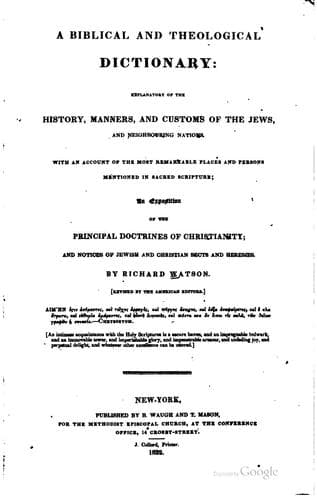
A Biblical and Theological Dictionary: explanatory of the history, manners, and customs of the Jews, and neighbouring nationsWatson, Richard
Religion
A Biblical and Theological Dictionary: explanatory of the history, manners, and customs of the Jews, and neighbouring nations
Watson, Richard
Bible -- Dictionaries; Theology -- Dictionaries
In his natural state he is fleet, fierce, formidable, and intractable;
but when domesticated, the most gentle of all animals, and assumes a
patience and submission even more humble than his situation. Le Clerc
observes, that the Israelites not being allowed to keep horses, the ass
was not only made a beast of burden, but used on journeys; and that even
the most honourable of the nation were wont to be mounted on asses,
which in the eastern countries were much larger and more beautiful than
they are with us. Jair of Gilead had thirty sons who rode on as many
asses, and commanded in thirty cities, Judges x, 4. Abdon’s sons and
grandsons rode also upon asses, Judges xii, 4. And Christ makes his
solemn entry into Jerusalem riding upon an ass, Matt. xxi, 4; John xii,
14. To draw with an ox and ass together was prohibited in the Mosaic
law, Deut. xxii, 10. This law is thought to have respect to some
idolatrous custom of the Gentiles, who were taught to believe that their
fields would be more fruitful if thus ploughed; for it is not likely
that men would have yoked together two creatures so different in their
tempers and motions, had they not been led to it by some superstition.
There might be, however, a physical reason for this injunction. Two
beasts of a different species cannot well associate together; and on
this account never pull pleasantly either in the cart or plough, and are
not therefore “true yoke fellows.” Le Clerc considers this law as merely
symbolical, importing that we are not to form improper alliances in
civil and religious life; and he thinks his opinion confirmed by these
words of St. Paul, 2 Cor. vi, 14: “Be ye not unequally yoked with
unbelievers;” which are simply to be understood as prohibiting all
intercourse between Christians and idolaters, in social, matrimonial,
and religious life. To teach the Jews the propriety of this, a variety
of precepts relative to improper and heterogeneous mixtures were
interspersed through their law; so that in civil and domestic life they
might have them ever before their eyes.
Public-domain text, read in full here on John Shaqi.
Reviews
Reviews
No reviews yet
Be the first to share your thoughts on this work.
Elsewhere in the archive
Join the Discussion
Join the discussion
Sign in to leave a comment or review.
Sign InorCreate an account